Indoor Cat Toys
How to Start a Cat Treat Puzzle and Try a Simple One Safely
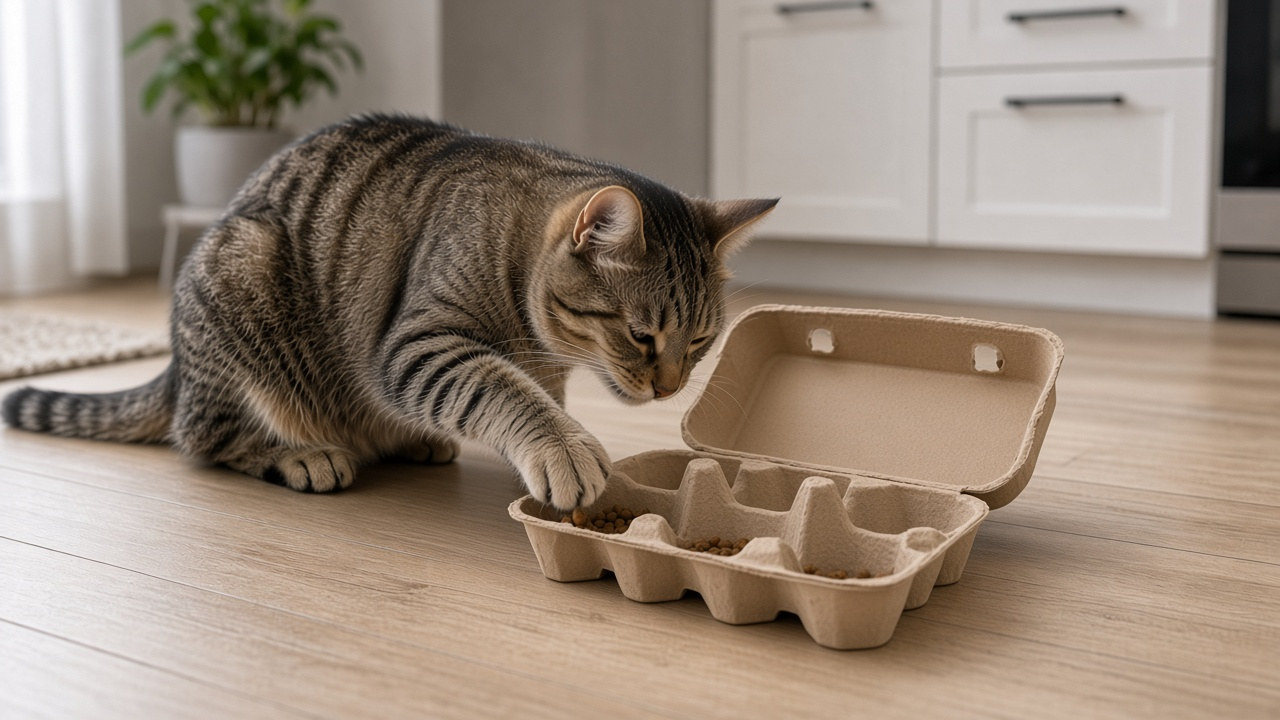
Learn how to start a cat treat puzzle the easy way, try simple homemade versions safely, and know when to move to a puzzle feeder—or skip puzzles altogether.
A cat treat puzzle is a simple food puzzle that makes the cat work a little for a treat or a few pieces of kibble. Many people start with something they already have: a muffin tin, an egg carton, or a loosely rolled paper bag. It is an easy way to test whether your cat will work for food.
It is not a hunt, and it is not automatically the same thing as a washable, everyday puzzle feeder. The sessions that help start easier than they look, stay supervised, and use a stable object with no staples or tight plastic. The ones that go badly leave shredded paper on the floor, start too hard, or turn treats into an uncounted second meal.
This guide is about how to start easy, how to try a few homemade versions safely, and when to move on to a real feeder—or skip puzzles altogether. It is not a ranked list of toys, and it is not a craft dump.
When a treat puzzle is the right first step
A cat treat puzzle is most useful when the job you want is a short, easy food problem, not a chase and not a finished feeding system:
- You want to test the idea before you choose a feeder for regular meals.
- You have a few minutes to stay in the room, and you can pick the object up when the food is gone.
- The cat is already eating well, and a small, visible amount of their usual food is enough for a first try.
- You want indoor time around a snack or part of a meal, without turning on a motorized toy.
It is the wrong tool, or the wrong moment, when:
- The cat needs easy access to calories, is underweight or recovering, has trouble chewing, or has been told not to work for meals. Ask your veterinarian before you change how that cat gets food.
- A kitten still swallows small parts, or still cannot afford a missed portion. Chewing and teething belong with teething toys, not with a meal puzzle made of cardboard.
- Two cats would be left to share one puzzle. Food inside an object is an easy trigger for guarding.
- You wanted a hunt. That is a wand session or other interactive play, not a treat puzzle.
- You will be out of the room. A homemade puzzle is a watched first try, not a workday feeder.
A skip is not a failure. A regular bowl, or a slow-feed bowl, is the better tool when a puzzle gets in the way of eating.
How to start easy—and try a simple one safely
1. Make the first session almost too obvious
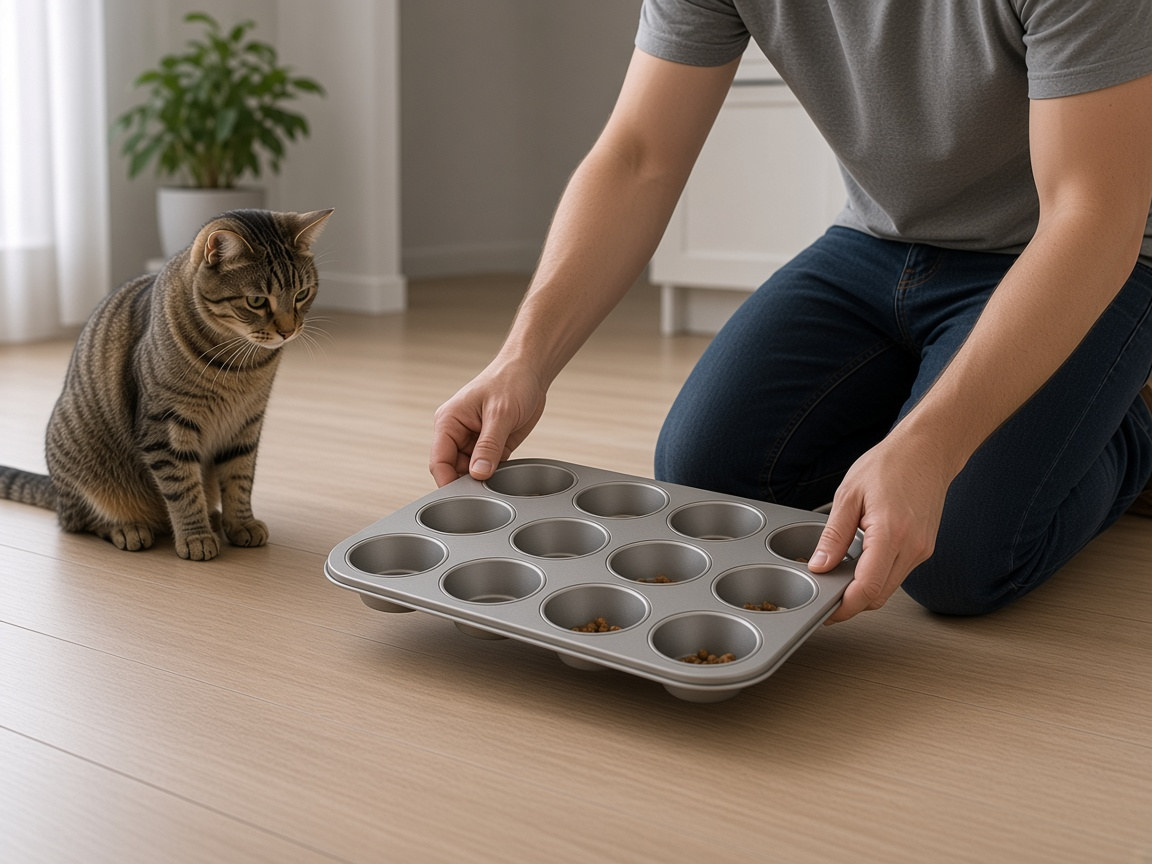
The cat has to learn that the object pays. For the first try, leave the food in plain view: open cups, a shallow tray, or a bag that is only loosely rolled. Stay in the room. Let them finish.
If the first puzzle is tightly closed, frozen, or buried under a stack of steps, many cats walk away still hungry—or start to tear the object apart. Easy first is still the right first step, even if the cat is “smart.” Intelligence is not the same as a willingness to work through an unfamiliar meal.
Use a small amount of food the cat already eats: a few pieces of their usual kibble, or a treat they already get. Subtract it from the day’s total. A treat puzzle is enrichment. It is still food.
2. Choose materials that can fail safely while you watch
Homemade puzzles are useful because they are simple. They are also easy to get wrong.
Use a clean, stable object. Remove staples, clips, and any tight plastic window. Do not use rubber bands, string, or tape the cat can swallow. Do not cut holes in a plastic bottle or tub and leave sharp edges. Do not offer a deep bag or box the cat can put their head into and have trouble backing out of.
Paper and cardboard are for supervised sessions only. When they are wet, shredded, or missing pieces, throw them away. A muffin tin or another washable tray can be reused after you wash it; a torn egg carton should not.
If a piece comes off, pick it up. If the cat starts to eat the material instead of the food, end the session. That setup is done.
3. Try one simple version, not a craft list
You do not need a special project. Three easy starting points are enough:
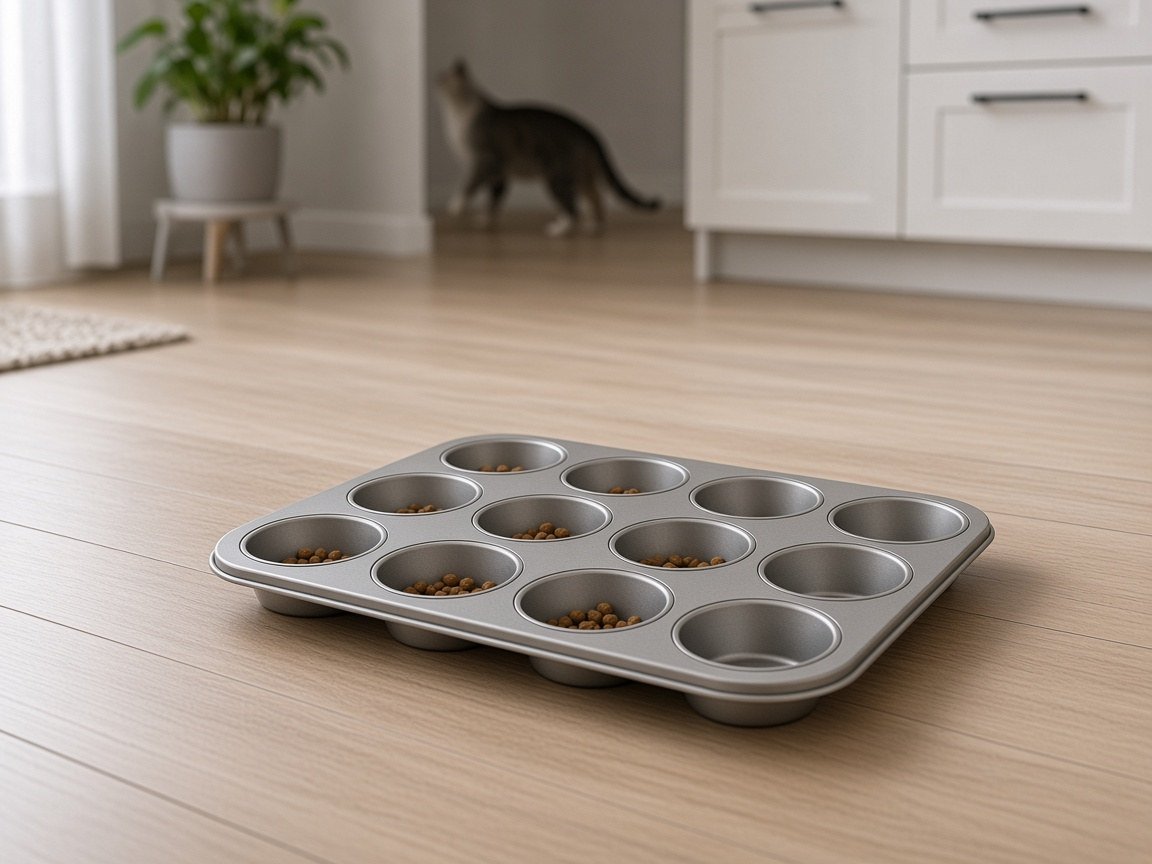
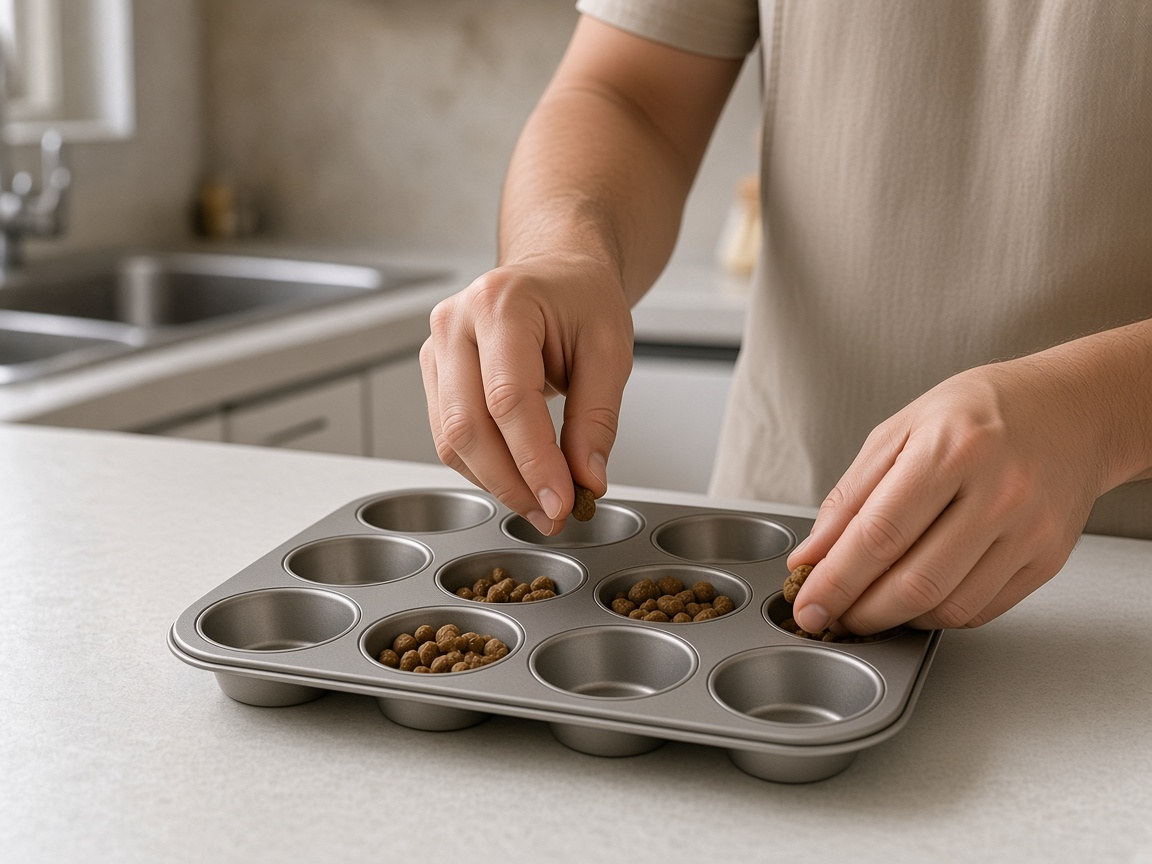
- A muffin tin, or another stable tray with shallow cups. Put a few pieces of kibble in some of the cups and leave them open. If the cat finishes calmly, you can later rest a lightweight cover—something too big to swallow—over one or two cups. Start with open cups.
- A cardboard egg carton, with the staples and any plastic removed. Leave it open, with food visible in the cups. Do not fasten it shut for the first session, and do not reuse it once it is chewed or damp.
- A small paper bag, loosely rolled, with a little kibble inside the cat can unroll or paw out. Skip plastic bags, long handles, and any bag deep enough for the cat to climb into. A toilet-paper tube with the ends folded loosely, not taped, can work the same way if you stay and then discard it.
The point is the same in each case: the cat can see or quickly reach the food, the object stays put, and you are there to stop a bad ending. One successful, easy session is more useful than three clever designs the cat cannot finish.
4. Stay present, then pick it up when the food is gone
Watch the first sessions. You need to know whether the cat can get the food, whether pieces come off, and whether another cat moves in.
The session ends when the food is gone, or sooner if the cat gets frustrated, guards the object, or starts to shred it. Pick it up. Do not leave a carton or bag on the floor “to see what happens” after you leave the room.
Wash anything you plan to use again. Throw away paper and cardboard that have already been worked over. A homemade puzzle left out becomes litter, and sometimes something to swallow.
5. Know when to move to a real puzzle feeder
A homemade treat puzzle is a test. It is a poor everyday meal plan.
Move to a washable, stable puzzle feeder when the cat clearly likes the easy game, you want to use it at meals, or you need something you can clean and use with a normal portion. Start that feeder easier than it looks. Match it to dry or wet food. Do not jump to a hard design because the homemade version went well.
If you only wanted a one-time experiment, you can stop here. You do not have to buy a feeder because the muffin tin worked once.
If the cat loved the game but you need wet food, daily washing, or a tool that will not be shredded, the homemade version has already done its job. The feeder guide is where difficulty, food type, and limits belong.
Common mistakes
Starting with a hard store puzzle, or a tightly closed homemade one, because the cat is “smart.” Make the first session easy, with food in plain view.
Leaving a paper bag, carton, or tube out when you are not in the room. Homemade puzzles are supervised.
Using staples, tape, rubber bands, string, or sharp-cut plastic, then hoping the cat will only eat the food.
Packing the puzzle with extra treats on top of a full day’s meals. Count whatever you put in.
Using wet food in cardboard or a loose bag. It soaks, spoils, and makes a mess. Wet food belongs in a shallow, washable tool.
Treating a successful DIY session as a reason to skip the questions a real feeder still has to answer: difficulty, stability, cleaning, and which cats should not work for meals.
Offering one puzzle to two cats and walking away.
How a treat puzzle differs from nearby options
A cat treat puzzle is a short, easy food job, often homemade, used to start or to test. The value is a low-stakes first success.
A puzzle feeder is the longer-term tool: you choose a difficulty the cat can finish, match it to dry or wet food, and wash it like a dish. Many products labeled cat puzzle toys are that kind of meal tool. This page does not replace that choice. It is the easy on-ramp.
A slow-feed bowl slows a meal with less problem-solving. Use it when you mainly want the cat to eat more slowly, or when any puzzle has already proved too frustrating.
A wand or other interactive play is a hunt. A treat puzzle will not complete that sequence, and a wand session will not replace a meal. They can share a day.
An automatic toy is for motion while you are gone, if you have already tested it in the room. A homemade treat puzzle is the opposite: it needs you there.
Dogs have their own versions of this job, including a puzzle toy and a snuffle mat. Do not hand a cat a large, hard dog puzzle and assume the difficulty will translate.
A simple way to try one
- Pick one stable, staple-free object—a muffin tin or an open egg carton is enough.
- Put a small amount of the cat’s usual kibble in plain view. Do not freeze it, close it tightly, or add a new rich treat for the first session.
- Stay in the room. Let the cat finish. If they start to shred the object or walk away hungry, pick it up and stop.
- When the food is gone, wash anything reusable and throw away paper or cardboard that is already torn. Do not leave it on the floor.
- If the cat worked calmly and ate what you offered, you can make the next session slightly less obvious—or, if you want this at meals, move to an easy puzzle feeder.
If the cat ignores the object, try a more familiar food and a more open setup before you assume they will never use one. If they only want to dump or eat the material, this may not be their tool. A bowl is a successful outcome when a puzzle gets in the way of eating.
FAQ
What is a cat treat puzzle?
A simple food puzzle that makes the cat work a little for a treat or a few pieces of kibble. Many people start with something homemade, such as a muffin tin, an egg carton, or a loosely rolled paper bag. It is an easy first try, not a hunt, and not automatically the same thing as an everyday puzzle feeder.
Is a cat treat puzzle the same as a cat puzzle feeder?
They are in the same family: the cat works to release food. A treat puzzle is often a short, easy session, sometimes homemade, used to test the idea. A puzzle feeder is the washable, stable tool you choose when you want that job at meals. How to pick difficulty, food type, and limits belongs with the feeder guide, not with a craft project.
How do I make a simple cat treat puzzle?
Start with a stable, staple-free object and food the cat already eats. An open muffin tin or egg carton with a few pieces of kibble in plain view is enough for the first try. Stay in the room, let the cat finish, then pick the object up. Do not begin with a tightly closed, hard-to-solve design.
What materials are safe to use?
Clean, stable items without staples, tight plastic, rubber bands, string, or tape the cat can swallow. Cardboard and paper are for supervised sessions only, and should be discarded once they are wet, shredded, or missing pieces. Skip bottles or tubs with sharp-cut holes, and skip anything that can slip over the cat’s head.
Can I leave my cat alone with a homemade treat puzzle?
No. Homemade puzzles are a watched first try, not a workday feeder. Paper and cardboard can be shredded and swallowed, and you need to see whether the cat can actually get the food. If you later want a meal tool you can leave for a short stretch, that is a stable, already-tested dry-food puzzle feeder, not a bag or carton.
Which cats should skip a treat puzzle?
Cats that need easy access to calories, are underweight or recovering, have trouble chewing, or have been told not to work for meals. Also skip it for a cat that guards food, a kitten that still swallows small parts, or a cat that only gets frustrated and walks away hungry. A regular bowl is the better tool when a puzzle gets in the way of eating.
Can I put wet food in a homemade treat puzzle?
Usually, no. Wet food soaks paper and cardboard, gets flung off a tin, and spoils if it sits out. If you want the cat to work for wet food, use a shallow, washable tray or a feeder meant to hold it, and wash it when the meal is over.
How much food should I put in?
A small amount: a few treats, or part of a regular meal. Subtract it from the day’s total. A treat puzzle is still calories, not a free extra. If the session is only a test, a handful of the cat’s usual kibble is enough.
When should I get a real puzzle feeder?
When the cat clearly likes the easy game, you want to use it more often, or you need something you can wash and use with a normal meal. Start that feeder easier than it looks, and use the homemade version only as a test, not as the everyday plan.
My cat ignores the puzzle, dumps it, or eats the cardboard. Now what?
Make it easier, put more food in plain view, and stay present. If they still walk away hungry, they may not be a puzzle eater—use a bowl. If they dump or shred the object to get the food faster, stop and pick it up. Eating the material is a reason to retire that setup, not to make a tougher one.