Indoor Cat Toys
How to Choose Automatic Cat Toys When Your Indoor Cat Is Home Alone
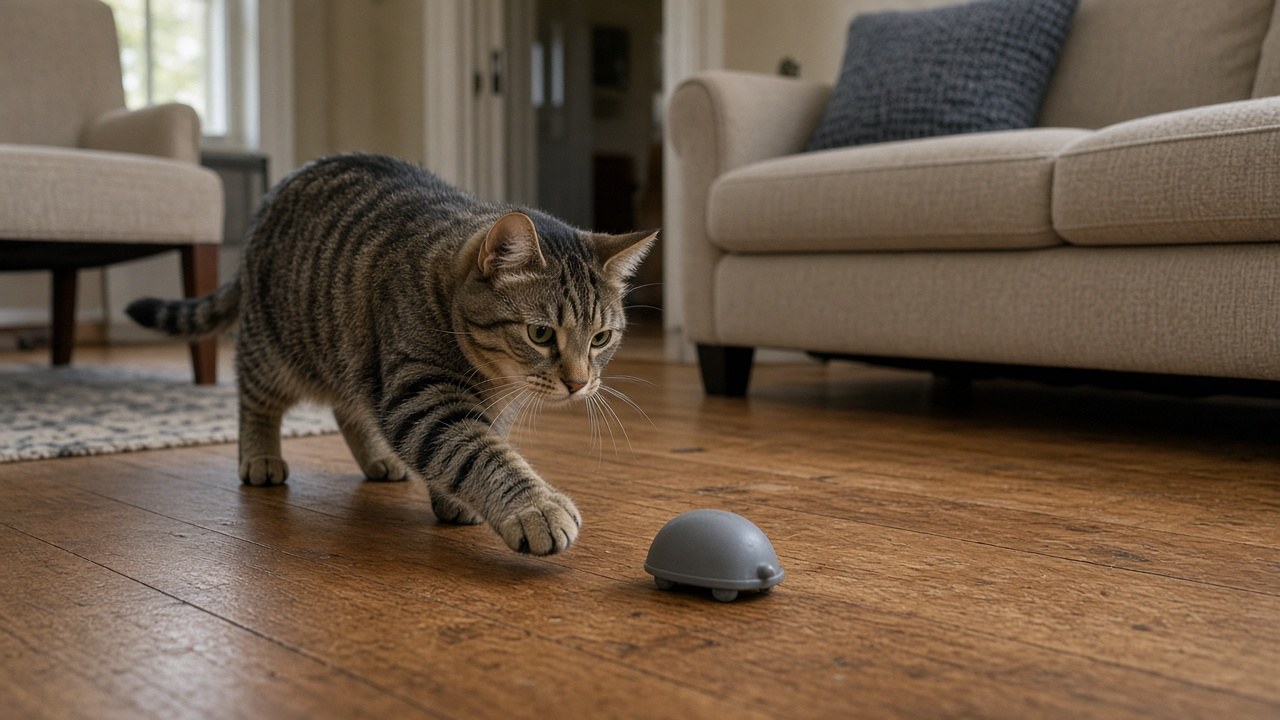
Choose automatic cat toys for indoor cats left alone: what to check for furniture snags, noise, battery life, and how they differ from laser pointers.
An automatic cat toy can keep an indoor cat occupied while you are at work, but only if it can run safely without you in the room. The models that disappoint usually fail in the same four places: they vanish under the couch, they are louder than a small apartment can hide, they run out of power mid-afternoon, or they are really just a laser the cat can never catch.
Choose for those constraints first. A ranked list of “best automatic cat toys” will not tell you whether a toy still helps at 2 p.m. in a furnished one-bedroom.
This guide is about how to pick and use one for solo indoor time—not which product to buy.
When an automatic toy actually helps
Automatic toys are most useful when the gap you are trying to fill is real play, not background motion:
- You have an indoor cat who is alone for a normal workday and comes to the door wound up or restless.
- The cat already likes to chase, bat, or pounce, and you want a short hunting burst while you are gone.
- You live in an apartment or a room with tight furniture, so the toy has to stay in a known area.
- You have more than one cat, and you need to watch whether one cat hoards the toy.
It is the wrong tool, or at least the wrong time to leave it running, when:
- A kitten still chews cords or shreds toys into pieces small enough to swallow.
- The toy has long strings, elastics, or ribbons that can wrap around a neck or limb.
- Your cat startles at motors, beeps, or sudden movement.
- You are hoping the toy will replace play with you. It will not.
If the main problem is a kitten chewing everything in sight, that is a teething issue, not an automatic-toy issue.
How to choose one you can leave in the room
1. Will it get stuck on the furniture?
Rolling balls and wandering mice fail most often in the room you actually have, not in a clear hallway. Low sofas, TV stands, dining chairs, and radiator gaps are classic traps. Once the toy is under a couch, your cat may either lose interest or spend the afternoon fishing for something you cannot reach until you get home.
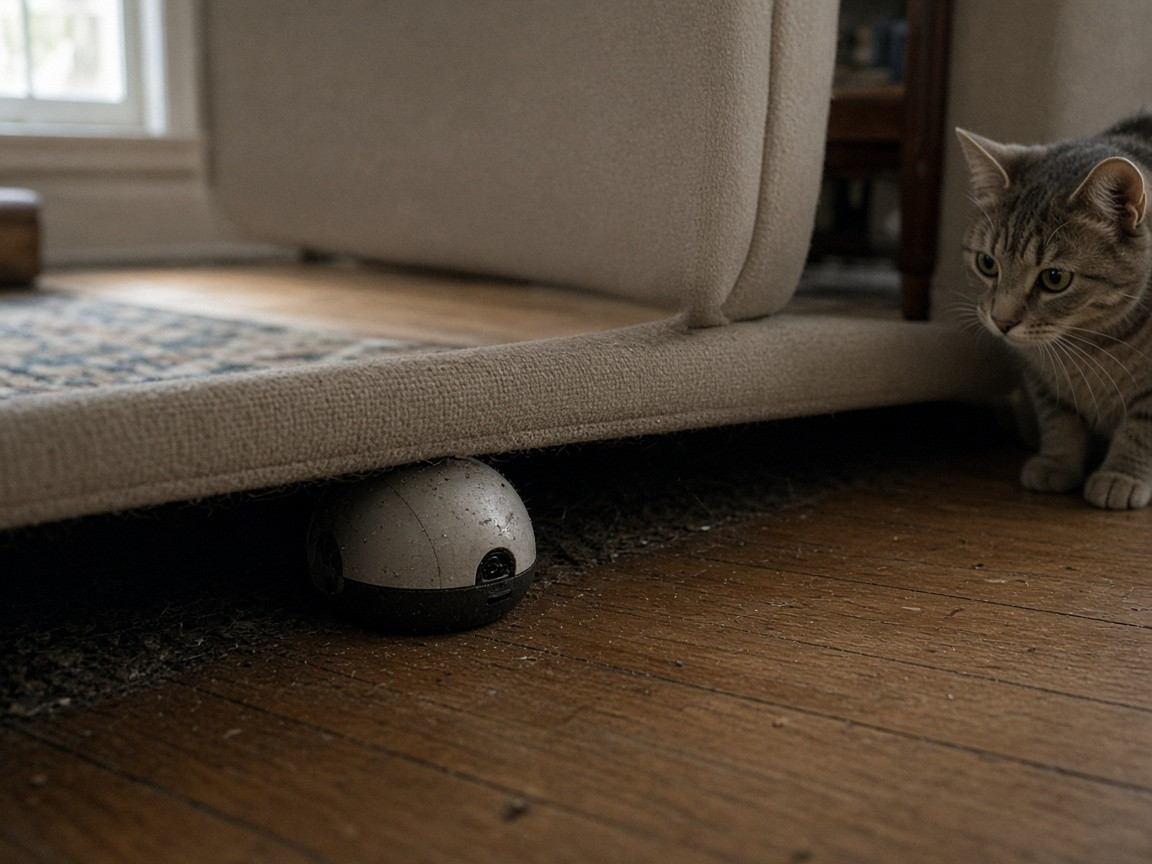
Before you rely on a toy during the workday, run it for 15–20 minutes in the real room, with the furniture as it is. Watch for three things:
- Does it travel under or behind furniture you cannot easily move?
- If it stalls or flips, does it stop on its own, or does the motor keep running?
- Can you keep it in a bounded area—a clear stretch of floor, a gated zone, or a room with the door cracked—without boxing the cat in?
A toy that stays in a predictable space is usually a better unsupervised choice than one designed to roam the whole apartment.
2. How loud is it, really?
Product videos rarely sound like a quiet apartment at 10 a.m. Listen for motor whine, startup chimes, and “success” beeps. Cats who startle will leave the room. In a small building, a chirpy toy can also become a neighbor problem.
Exciting is not the same as useful. For daytime solo play, a steady, relatively quiet motor beats a toy that talks, plays music, or beeps every time it changes direction. If you work odd hours, or the toy might run while someone is sleeping, treat noise as a deal-breaker, not a minor flaw.
3. Will the battery or charge last through the sessions you planned?
You do not need a toy that moves for eight hours straight. You need one that still has power for the two or three short sessions you actually scheduled.
Check three practical points:
- After a full charge, or with a fresh set of batteries, does it complete the sessions you have in mind—for example, a few 10–15 minute bursts—without dying before late afternoon?
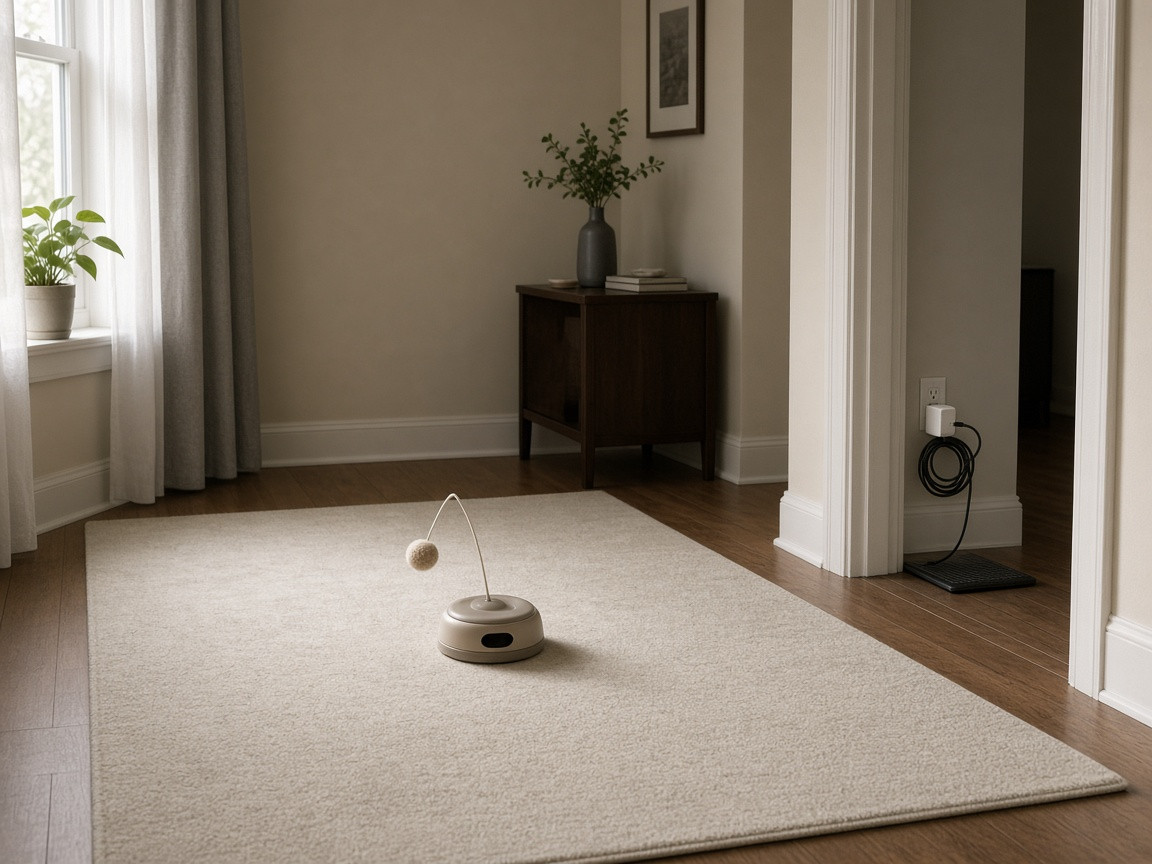
- If it is rechargeable, can you charge it outside the play area so the cable is not left where the cat can chew it?
- If it uses replaceable batteries, will you actually notice when they start to sag? Weak batteries often turn a lively toy into a slow, disappointing wobble.
Rechargeable and replaceable batteries can both work. The failure mode is the same: the toy is dead or sluggish at the hour you needed it.
4. Can the cat finish the hunt?
Cats hunt in a sequence: orient, stalk, chase, pounce, and—when the sequence goes well—catch. A toy that only spins in place, or a light the cat can never touch, often leaves them watching, not playing.
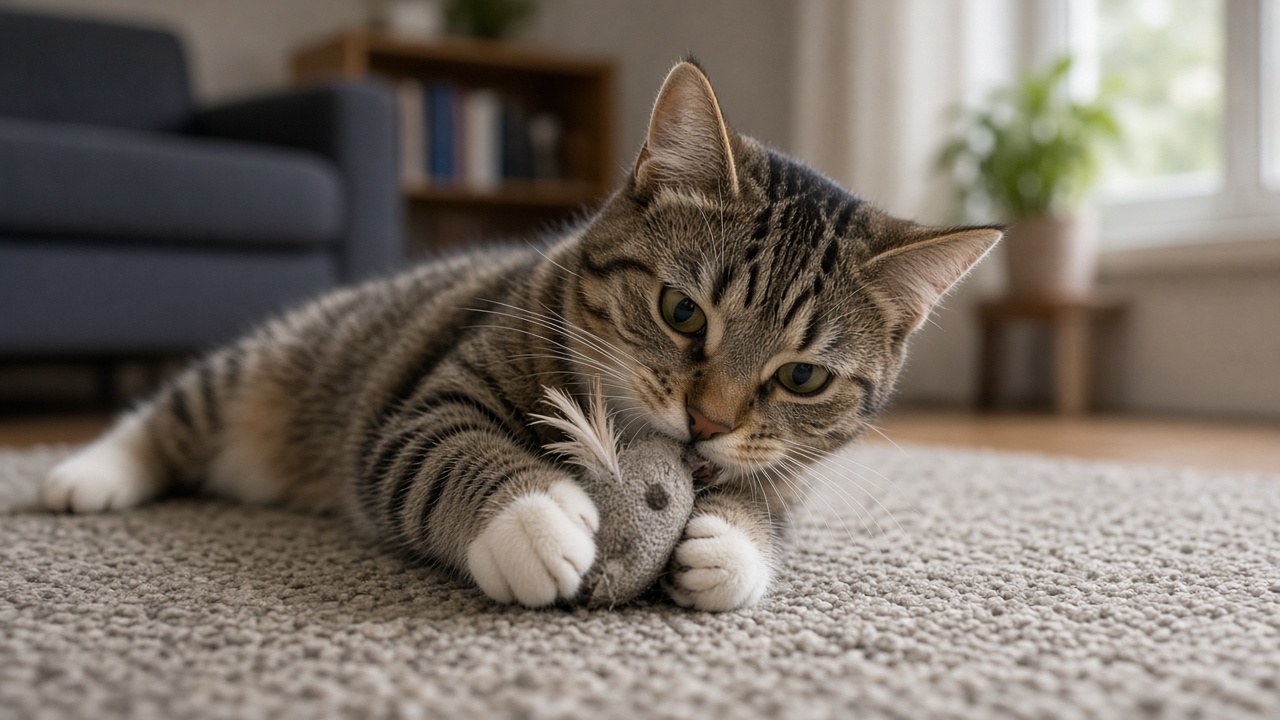
Look for motion that starts and stops, changes direction, and pauses long enough for a pounce. The cat should be able to bat, pin, or briefly “catch” a physical object. That ending matters more than how erratic the first five seconds look in a product clip.
If your cat only stares, the toy may be too fast, too loud, too repetitive, or impossible to contact. That is a design mismatch, not a sign that automatic toys “don’t work.”
5. Use a timer, not an all-day switch
Short, scattered sessions are easier on the cat, the motor, and the battery. A toy that runs all day becomes furniture. It can also overstimulate some cats, or leave a motor pushing against a chair leg for hours after it gets stuck.
Prefer a timer, a schedule, or a simple auto-off after 10–15 minutes. Automatic shutoff when the toy is jammed is a safety feature, not a luxury. Until you have watched a few sessions, do not treat “automatic” as “safe to ignore.”
6. Inspect the parts that can fail when you are not home
Feathers, felt mice, plastic clips, and dangling attachments come off. Strings and elastics can wrap. Small pieces can be swallowed. Any toy you leave out should still be safe if it loses its most tempting bit.
Skip unsupervised use of anything with a long cord, ribbon, or loop. Keep charging cables out of the play zone. If your cat is a shredder, check the toy at the end of each day for the first week, and retire it if pieces start coming off.
Common mistakes
Leaving it on all day. The cat habituates, the battery dies, and a stuck motor keeps working in a gap you cannot see.
Choosing the loudest, most chaotic toy. That reads as “more interactive” in a video and often reads as “alarming” in a quiet room.
Treating the automatic toy as the whole plan. A wand or fishing-pole style session when you get home still does a job the machine cannot: you control the pace, you can end on a catch, and your cat gets play with you.
Testing it in an empty hallway, then using it in a furnished living room. The furniture is the test.
Assuming two cats will take turns. One cat may guard the toy. Watch the first sessions. If that happens, you need a second play option or a separate time window—not a more intense toy.
Leaving the charging cable in the play area because it is “only charging overnight,” then forgetting it is still there in the morning.
Expecting a shy, older, or low-drive cat to self-start with a new device. Introduce it while you are in the room, keep the first sessions short, and stop if the cat leaves.
How automatic toys differ from similar options
Automatic toys vs laser pointers
This is the comparison people blur most often. Many store pages file automatic lasers under automatic cat toys, but the jobs are not the same.
A laser—handheld or automatic—triggers chase. The cat usually cannot catch it. Some cats stay amped up or keep sniffing the floor after the light is gone. If you use a laser at all, end the session with a physical toy or a treat the cat can actually grab. Do not aim a laser at a cat’s eyes, and be cautious with automatic lasers that wander; the cat may look into the source.
For time when you are not home, a toy with a real object the cat can bat is usually the better fit. An automatic laser can create the hunt without the catch, which is the opposite of what a solo session should provide.
Automatic toys vs wand toys you hold
A wand or tease toy is for when you are there. You can slow down, speed up, let the cat catch, and stop before the session goes frantic. Automatic toys fill the hours in between. They do not replace that interaction, and they should not be asked to.
If you want a fuller plan for indoor cats—apartments, multi-cat homes, and days when no one is home—that belongs with interactive play, not only with a motorized toy.
Automatic toys vs puzzle feeders
A food puzzle or slow feeder occupies a cat by making them work for a meal. An automatic motion toy is for the hunting sequence. They can live in the same day, in different windows. One does not replace the other. If the cat is already food-motivated and you only add another moving object, you may be solving the wrong problem.
Try it on a weekend before you trust it on a workday
- Charge it fully, or put in fresh batteries.
- Set a 10–15 minute session in the room the cat will actually use, furniture included.
- Watch: does it get stuck, is the sound startling, and does the cat hunt, watch, or leave?
- Repeat for a few days, only in short sessions, and see whether interest holds after the novelty fades.
- Only then use it while you are out—and still do a real play session when you get home.
If it fails the weekend test, it will not magically work better on a Tuesday afternoon.
FAQ
Are automatic cat toys safe to leave on when I go to work?
Only after you have watched the toy in that room. It should not be able to wedge into a tight space, wrap a cord or string, or keep running after it stalls. Automatic means the toy can start and stop itself. It does not mean it is safe to ignore.
How long should each session last?
Short bursts are enough for most cats. A few 10–15 minute sessions usually beat hours of continuous motion. All-day running drains power, becomes background noise, and raises the chance that a stuck toy keeps working while you are gone.
Will my cat get bored of an automatic toy?
Often, if it is always on the floor or the motion never changes. Put it away between sessions, use a timer, and keep a real interactive session when you are home. Rotation matters more than buying a second motorized toy right away.
Do these toys work for older or less playful cats?
Sometimes. A low-drive or sound-sensitive cat may only watch, or may leave. Introduce the toy while you are present, keep sessions short, and do not force it. A quiet, start-and-stop motion is a better first try than a fast, noisy one.
Can two cats share one automatic toy?
They might, or one cat may keep the other away from it. Watch early sessions. If one cat guards the toy, add a second play option or a separate window rather than turning the existing toy up.
Why does my cat only watch the toy and not play?
The motion may be too predictable, too fast, too loud, or impossible to catch. Try a toy the cat can actually bat, and start a session after a short wand play so the cat is already in hunting mode. Some cats also need a day or two before they will approach a new device.
Is a rechargeable toy better than one that uses batteries?
Either can work. What matters is whether a full charge or a fresh set of batteries covers the sessions you scheduled, and whether the charging cable can stay out of the play area. Rechargeable toys fail when they are not charged. Battery toys fail when no one notices the cells are weak.
Can I use an automatic toy with a kitten?
Be more conservative. Young kittens chew cords and are more likely to swallow small parts. Supervised play is the safer default until you know the kitten will not shred or ingest pieces. If the main issue is chewing, look at teething toys rather than a motorized solo toy.