Kitten Teething Toys
Kitten Teething Toys: What They Can Chew, What They Can't, and When It Ends
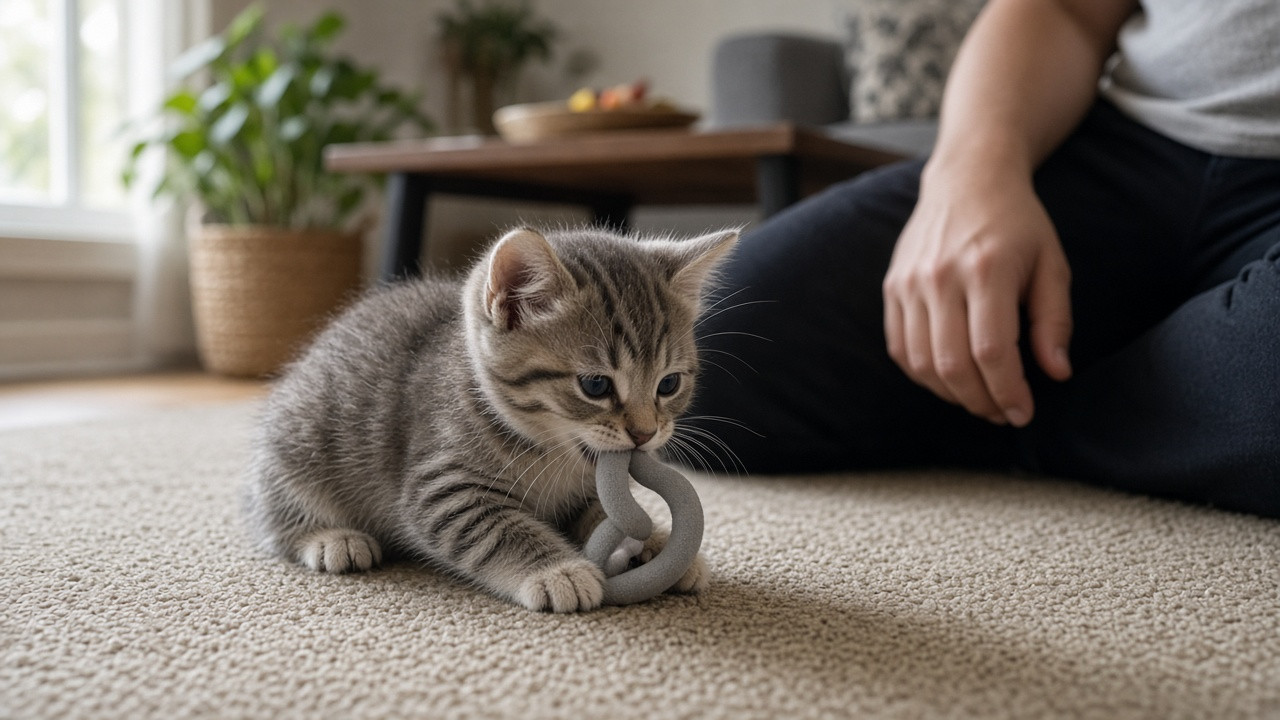
A complete guide to kitten teething toys: what kittens can and can't chew, how these toys differ from adult cat toys, and when teething typically happens.
A teething kitten will chew. The useful question is not “what is the best kitten teething toy.” It is what this kitten can safely put in their mouth, what must stay out of reach, and whether the chewing you are seeing still fits a normal teething window.
Most search results for kitten teething toys are product shelves, short Reddit threads, or lists that mix puppies and kittens together. This guide collects those scattered questions into one place: the typical timeline, what is safe to chew, what is not, and how teething toys differ from the wand, laser, and automatic toys made for adult cats.
This is not a product ranking, and it is not a substitute for veterinary care. If your kitten will not eat, has heavy bleeding, swelling, or a smell from the mouth that seems off, or if baby teeth stay put while adult teeth are coming in, call your veterinarian.
When teething usually happens
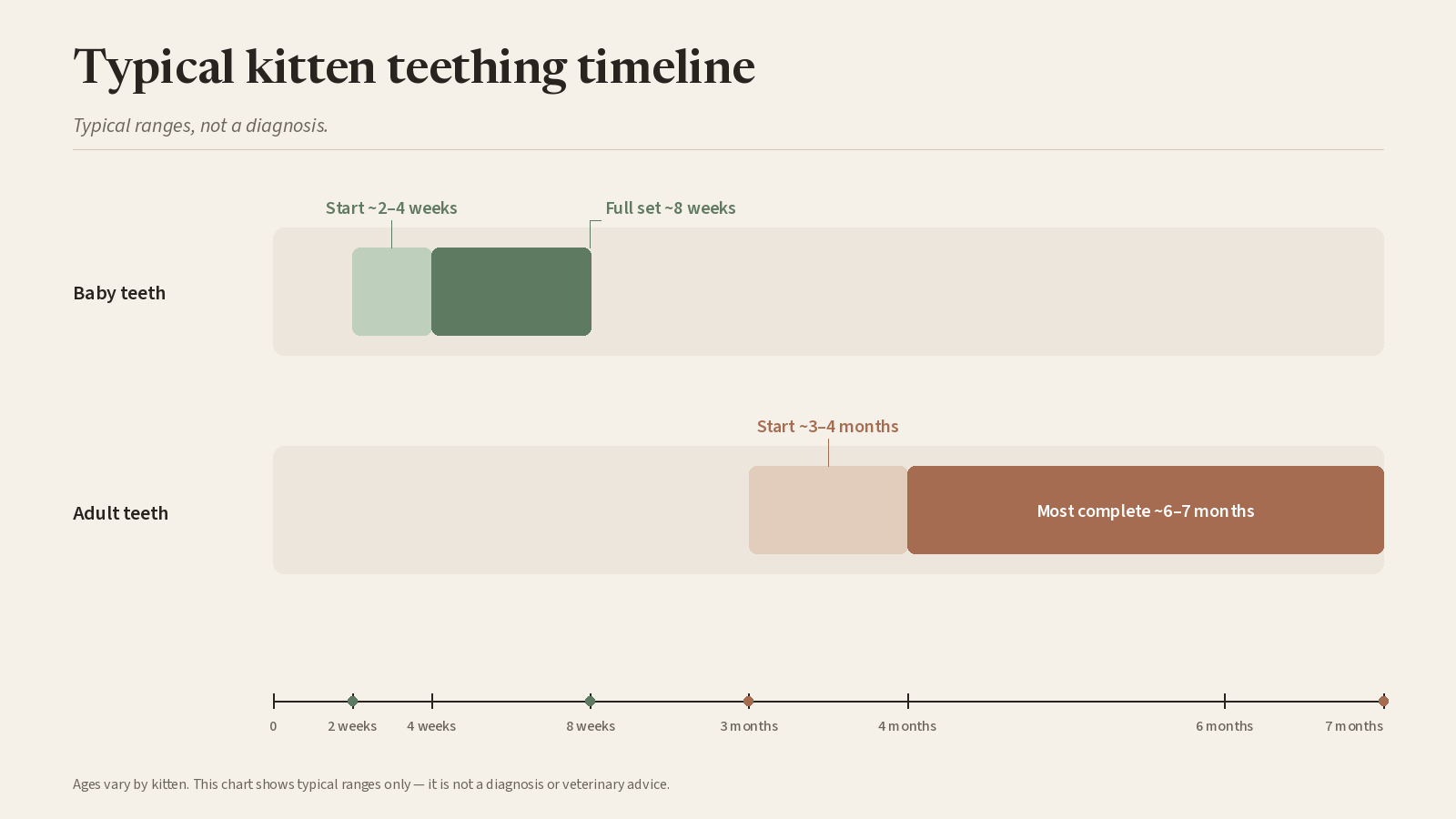
Kittens are born without teeth. Baby teeth typically start to erupt around two to four weeks of age—incisors first, then canines, then premolars—and most kittens have their deciduous set in by about eight weeks. Those baby teeth later fall out as the adult teeth come in, often beginning around three to four months and finishing, for many kittens, around six to seven months. Adult cats usually have 30 teeth; kittens have fewer baby teeth, and the first molars appear only in the adult set.
The uncomfortable stretch people notice most is often the second wave: the months when adult teeth are pushing through. Gums can be sore, the kitten may drool a little, chew more, or be fussier about hard kibble. A small smear of blood on a toy can happen when a baby tooth is loosening. A little softness around the gums is also common. Heavy bleeding, refusal to eat, facial swelling, or baby teeth that do not give way to adult teeth are not something to wait out.
Not every kitten follows the same calendar. Large-breed and small-breed kittens, litter mates, and kittens who had a rough start can run a little early or late. The timeline is a guide for what “teething” usually means, not a diagnosis. If eruption seems badly out of step, or chewing continues hard after the adult teeth should be in, ask your veterinarian. Persistent chewing after teething can be play, habit, or a different problem, including pica—not a reason to keep treating the kitten like they are in a teething window forever.
Until the adult teeth are in, assume the mouth is a work in progress: softer food if they shy away from hard kibble, short play, and chewable items you have already inspected.
What a kitten can chew
A good teething toy is something the kitten can gum and bite that stays in one piece, fits a small mouth, and does not shed bits they can swallow.
Look for:
- A soft or slightly yielding texture, sized for a kitten, not a large-dog chew.
- A simple shape with no small add-ons: no loose bells, plastic eyes, glued-on parts, or thin ribbons.
- A material you can wash, and a toy you can retire the moment it cracks, frays, or starts to come apart.
- Something you can offer for short, supervised sessions, then put away, just as you would with any food-based toy.
Slightly cool can be soothing for some kittens. If you chill a soft, kitten-safe rubber toy, keep it cool rather than rock-hard frozen, and stay in the room. A toy that is too hard can be uncomfortable on sore gums, and anything that breaks into chunks is a risk.
Play still matters during teething. A short wand session, ending on a catch, gives the kitten a hunt. That is a different job from a chew. Keep the two separate: a teething toy is for the mouth; a wand is for stalking and pouncing, and it should not be left out afterward for the kitten to shred the string. How to shape indoor play—apartments, more than one cat, and days you are gone—is covered in our guide to interactive cat toys for indoor cats.
Rotate two or three chewable toys rather than leaving a pile out. Inspect them at the end of the day. Wash them. If the kitten ignores a toy and goes back to a power cord, the toy may be the wrong texture, or the cord may simply be more available. Manage the environment: hide cords, pick up hair ties, and offer the legal chew when you see the kitten start to mouth something else.
Hands are not teething toys. If the kitten bites your fingers, redirect to the toy and end the game if they keep coming back to skin. What you allow at ten weeks is much harder to undo at ten months.
What a kitten should not chew
Most of the real risk is not “the wrong brand.” It is ordinary household objects, and adult cat toys that were never meant to be left in a kitten’s mouth.
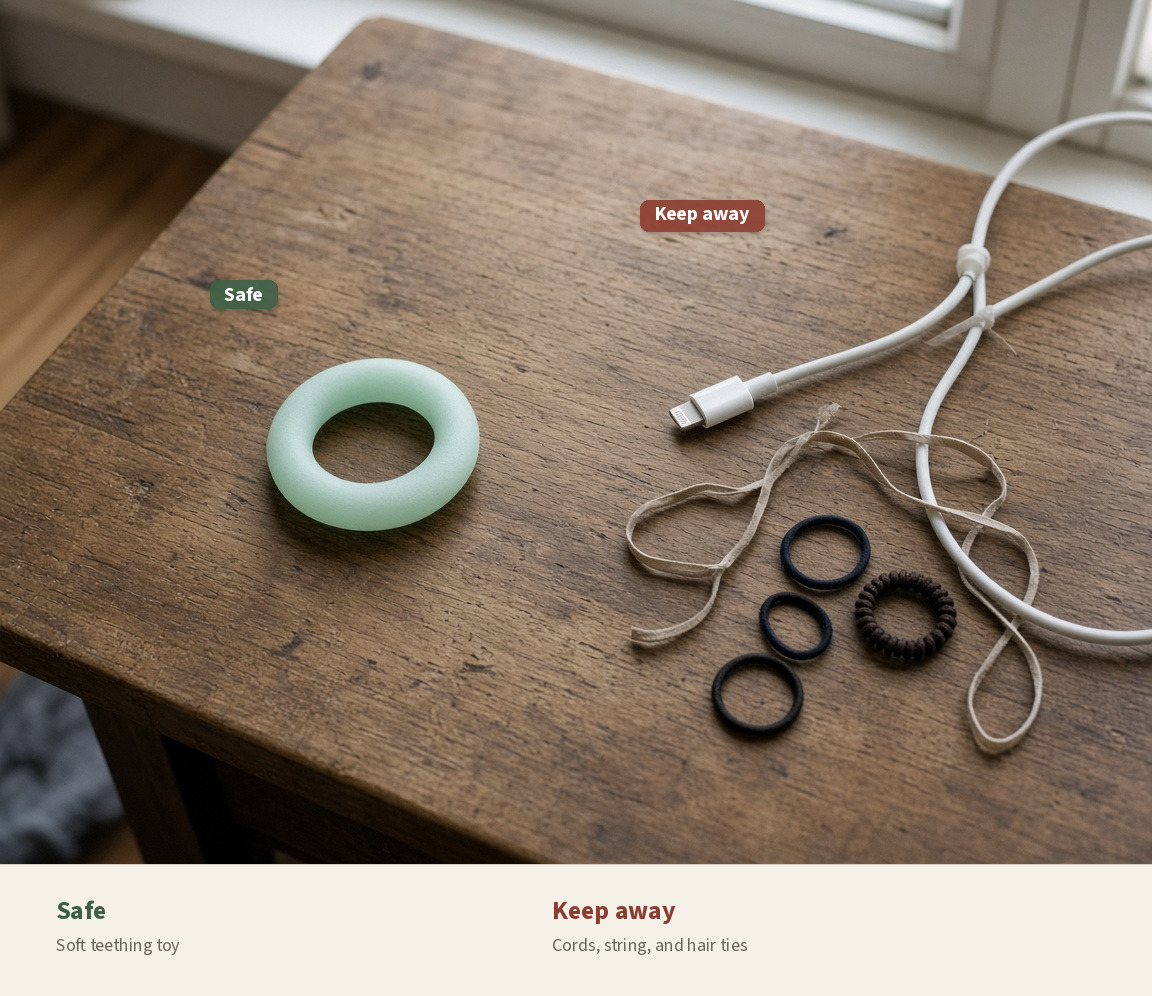
Keep out of reach, or use only with close supervision and a plan to put them away:
- Strings, yarn, ribbons, rubber bands, hair ties, dental floss, and wand teasers left on the floor. These can wrap or be swallowed.
- Feathers, felt mice, and stuffed toys that shed filling, bells, or plastic clips.
- Charging cables, lamp cords, and the power leads on automatic toys. A teething kitten will find them.
- Anything small enough to swallow whole, or that can snap into a swallowable piece: broken plastic, bottle caps, foam, eraser-like bits.
- Human teething gels, essential oils, or numbing products made for people. Do not put these on a kitten’s gums.
- Dog chews, hard nylon bones, cooked bones, and large, rigid puppy teethers. A toy sized or hardened for a puppy’s jaw is often the wrong object for a kitten.
- Houseplants, plastic bags, and anything the kitten is using as a chew because it was simply left out.
If you would not want it inside a kitten, it is not a teething toy. When a “cat toy” starts to come apart, retire it. A damaged toy is no longer safe just because it was sold for cats.
Automatic and motorized toys are a poor unsupervised choice in this window, even if they will be useful later. The kitten may chew the housing or the cable, and the toy may disappear under furniture. Wait until you know the kitten leaves cords and small parts alone, and use the checklist in our automatic cat toy guide before you ever leave one running in an empty room.
How kitten teething toys differ from adult cat toys
Adult cat toys are usually built for a hunt, not for sore gums. Wands, lasers, automatic rollers, and kickers can be fine in a supervised play session, but they are doing a different job, and they often fail as chew objects.
The differences that matter:
- Purpose. A teething toy should be legal to bite and gum. An adult interactive toy should be legal to chase, then put away. If you only buy hunt toys, the kitten will still teethe—on whatever is handy.
- Size and parts. Adult toys may include small attachments, longer strings, and stuffing a grown cat is less likely to swallow. A kitten can tear and ingest those pieces more easily.
- Supervision. A teething kitten needs a higher standard: if it can fray, it should not sit out.
- Duration. Teething is a months-long window, then it ends for most cats. Adult play does not end. When the adult teeth are in, keep the hunt toys and retire anything you only offered as a soother, especially if it is worn.
- Texture. Hard or very bouncy adult toys can be unappealing or uncomfortable while gums are sore. Soft and simple usually wins during the worst weeks.
Catnip is optional and often less interesting to very young kittens. It is not a teething treatment. Do not count on it to make a toy safer or more “for kittens.”
Common mistakes
Treating every chew as a shopping problem, then leaving hair ties and cords on the floor.
Using a wand, a stuffed mouse, or a puppy chew as a teething stand-in, and leaving it out.
Putting human teething gel, essential oils, or other numbing products on the kitten’s gums.
Assuming a little blood on a toy is always fine, or, the other way, panicking at a faint smear but ignoring a kitten that has stopped eating.
Buying a pile of adult “interactive” toys and skipping anything the kitten is actually allowed to bite.
Letting the kitten teethe on hands because it looks cute at twelve weeks.
Leaving an automatic toy or its charger in the room “just this once.”
Keeping a frayed toy in circulation because the kitten likes it. That is the moment to replace it, not the moment to leave it out longer.
A simple way to get through the window
- Kit-proof the room: cords tucked away, strings and bands picked up, plants and bags out of reach.
- Offer one or two simple, washable, kitten-sized chews for short sessions, and inspect them every day.
- Give the kitten a real play session with a wand or teaser, then put the string away and offer the chew if they still want to mouth something.
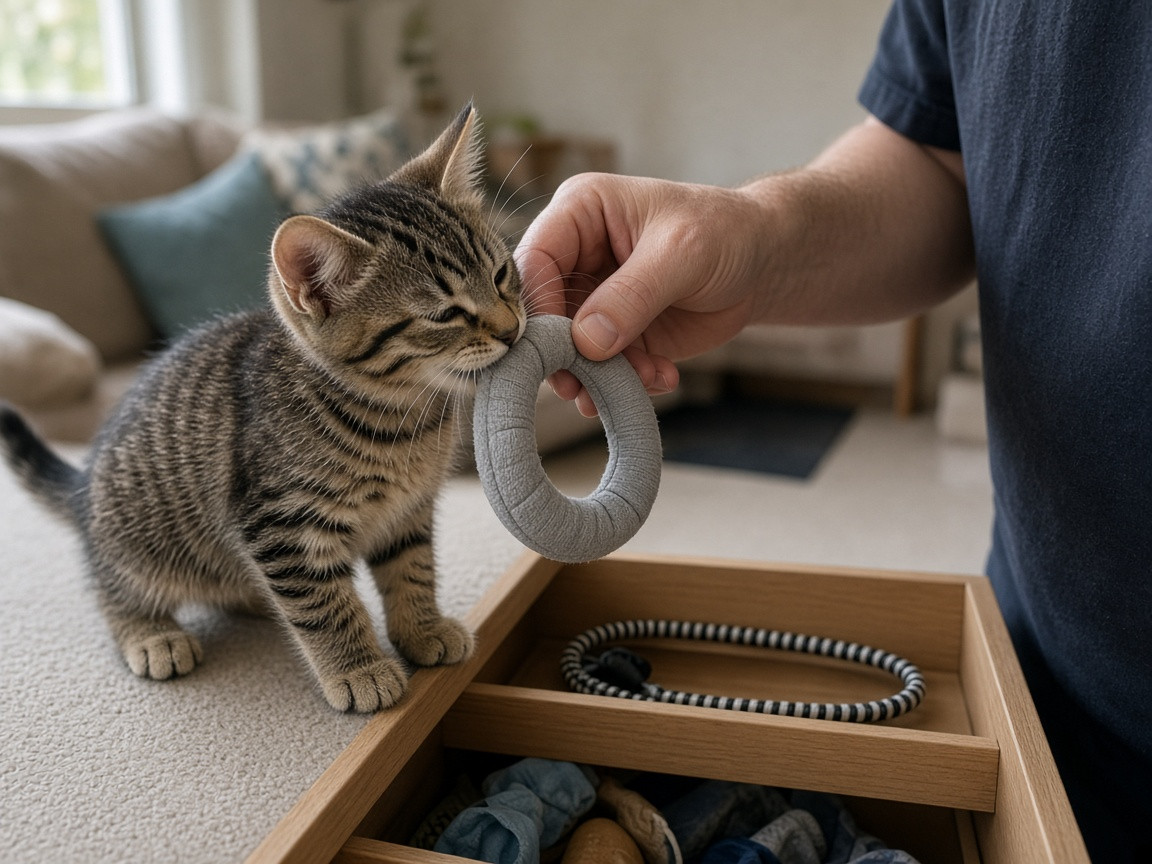
If the kitten still attacks household objects after the adult teeth are in, treat that as a new question—habit, play, diet, or a veterinary issue—not as an excuse to buy more teething toys.
FAQ
What are kitten teething toys?
Toys a kitten is allowed to bite and gum while baby teeth come in and adult teeth replace them. They should be simple, kitten-sized, and safe if mouthed hard. They are not the same thing as a wand, a laser, or an automatic toy, even though those may also be used in the same months.
When do kittens start and finish teething?
Baby teeth often start around two to four weeks and are usually in by about eight weeks. Adult teeth often start coming in around three to four months and, for many kittens, have come through by about six to seven months. Individual kittens vary. Your veterinarian can tell you if the schedule looks off.
What can kittens chew on when they are teething?
A soft, simple, kitten-sized toy that does not shed parts, does not include string, and can be washed and retired when it wears out. Offer it in short, supervised sessions. Slightly cool, soft rubber can help some kittens; rock-hard frozen objects are a poorer idea.
What should kittens not chew on?
Strings, yarn, ribbons, hair ties, cords, loose feathers and stuffing, small plastic parts, human teething products, hard dog chews, and any toy that is already coming apart. If they can swallow it, or swallow a piece of it, it is not a teething toy.
How are teething toys different from regular cat toys?
Teething toys are for the mouth. Most regular cat toys are for a hunt and should be put away after play, especially anything with a string. Adult toys are also more likely to have parts a kitten can tear off and swallow. You may need both kinds of play during these months. You should not ask one toy to do both jobs unsupervised.
Is it normal for there to be a little blood on a toy?
A faint smear can happen when a baby tooth is loosening. Heavy bleeding, a kitten that will not eat, swelling, or a bad smell from the mouth is not something to manage with a new toy. Call your veterinarian.
Can I use puppy teething toys for a kitten?
Not as a default. Many puppy teethers are too large, too hard, or made for a different kind of chewing. If a toy was designed for kittens, or is clearly soft, simple, and sized for a small mouth, the label matters less than those traits. The safety rules stay the same.
My kitten chews my hands and cords. What should I do?
Make the unsafe objects boring and unavailable, and offer a legal chew the moment the mouth starts working. Do not keep fingers in the game. End play if the kitten keeps going for skin. Cords should be hidden, not used as a redirect toy.
Do I still need playtime if I have teething toys?
Yes. Chewing and hunting are different. A short wand session, ending on a catch, still helps an indoor kitten, and the teaser should be put away afterward so it does not become a string to swallow.
When should I stop offering teething toys?
When the adult teeth are in and the sore-gum window has passed, you can retire worn chews. Keep toys that are still safe to play with, and keep string toys out of reach between sessions. If hard chewing continues well past this point, ask your veterinarian instead of stocking more teething products.