Dog Puzzle Toys
How to Choose a Dog Puzzle Toy by Difficulty—and When to Stop
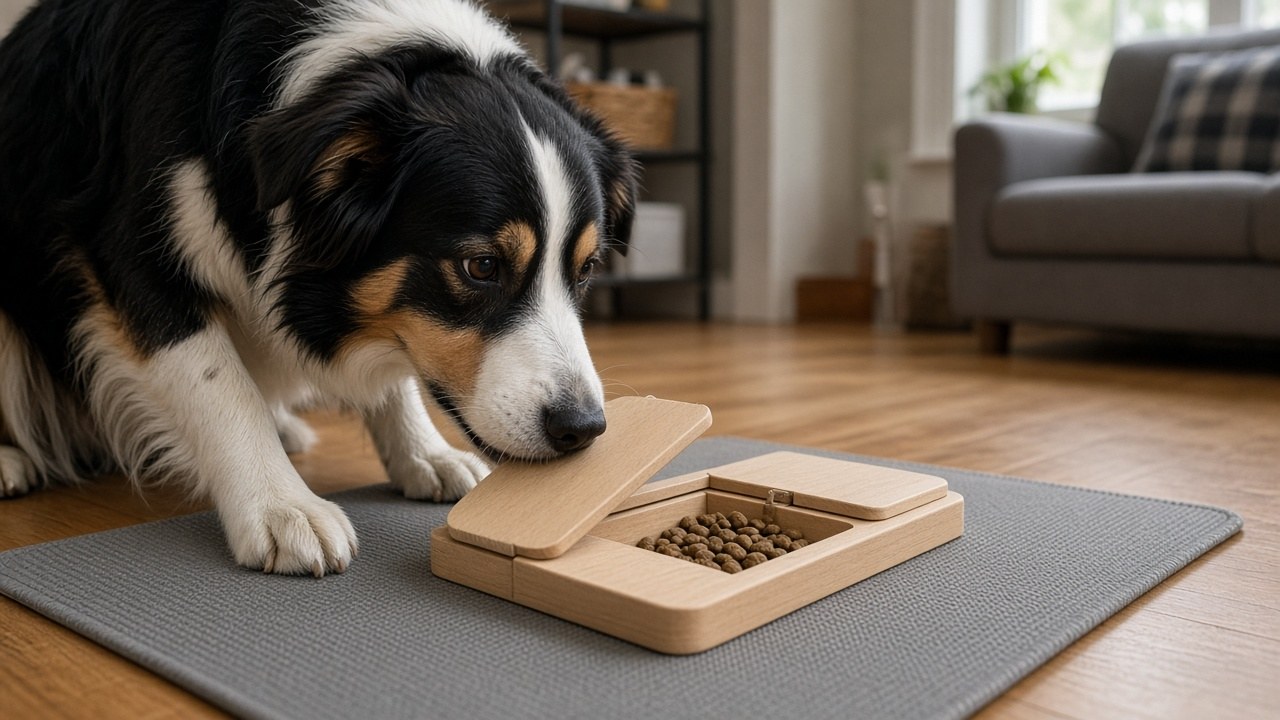
Learn how to use a dog puzzle toy at the right difficulty, when it is the wrong tool, and how it should share the job with a snuffle mat or slow feeder.
A dog puzzle toy only works at the right difficulty, for the right job, and with a clear point to stop. Too easy, and the food is gone in ten seconds. Too hard, and the dog chews the toy, quits, or gets more frustrated than tired. A ranked list of “best puzzle toys” will not tell you which of those is happening in your kitchen.
This guide is about how to grade the challenge, when a puzzle is the wrong tool, and how it should share the day with a snuffle mat or a slow-feeder bowl. It does not rank products.
When a puzzle is the right tool
A puzzle is most useful when you want the dog to think: to nudge, lift, slide, or sequence actions in order to get food. That is a different job from running, and a different job from sniffing through fabric.
It is a good fit for:
- A dog that already understands that working an object can produce food, or is ready to learn that in an easy first session.
- Indoor time, rest days, or evenings when you want mental work with little impact on joints.
- A meal or part of a meal you are willing to deliver slowly, with calories counted in the day’s total.
- A household that can offer the puzzle to one dog at a time, then pick it up when the food is gone.
It is the wrong tool, or the wrong moment, when:
- The dog shreds plastic, rubber, or small parts and may swallow them.
- You need an everyday, easy-to-wash way to slow down a meal. A slow-feeder bowl usually does that job with less frustration and less destruction.
- You need a calm, nose-down search after a chase. An easy forage, such as a snuffle mat, or a lick mat, is usually a better cool-down than a hard puzzle.
- Two dogs would be left to share one puzzle. Food inside a toy is a common trigger for guarding.
- The dog is already over-aroused, in pain, or too tired to problem-solve. A harder puzzle will not settle that dog. It will wind them up or shut them down.
A puzzle is also the wrong answer if you are hoping it will babysit a dog all day, stop barking by itself, or replace walks and sniff time outdoors. It is a short, food-based work session.
Difficulty levels that actually help you choose
Ignore marketing that says “advanced” or “for smart dogs.” Grade the puzzle by what the dog has to do, and by how long they can work without getting stuck or angry.
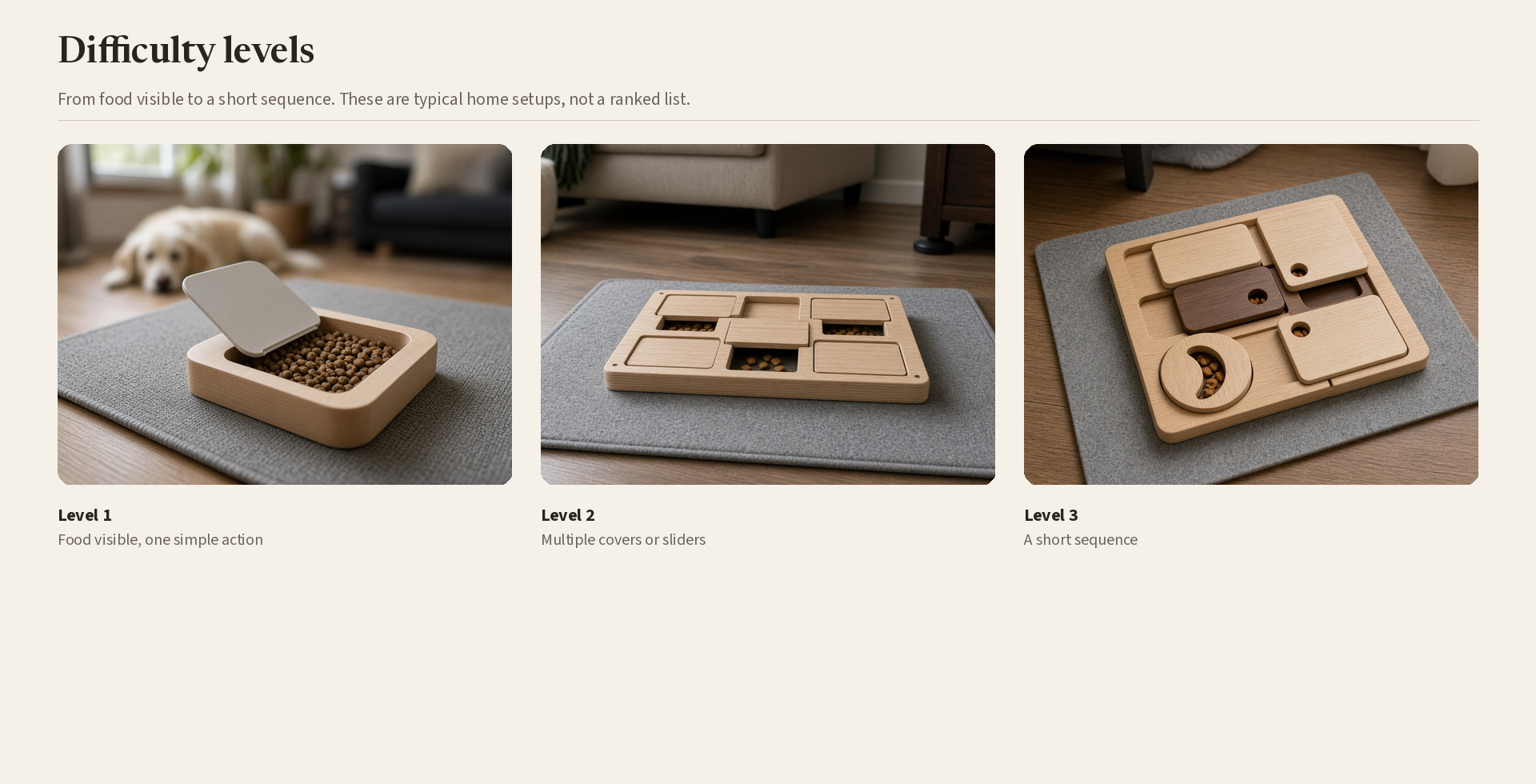
Level 1: The dog learns that the toy pays
Food is visible, or almost visible. One simple action gets it out: nudging, tipping, rolling, or flipping a shallow cover. The dog should succeed in the first session, often in just a few minutes.
This is where almost every dog should start, including dogs that seem clever. The goal is not to challenge them. It is to teach a clean pattern: work the object, get the food, the game stays fair.
Level 2: More hiding places, still easy to win
The dog has to work more than one spot, or do a slightly less obvious action: sliding a cover, lifting a flap, turning a piece. The sequence is short, and a stuck moment is easy to unstick with a hint.
Use this when Level 1 is finished quickly and calmly, and the dog leaves the toy intact. If they start to chew the covers or flip the whole board over to dump it, stay here or go back a step rather than buying something “harder.”
Level 3: The order starts to matter
The dog has to do steps in a sequence, hold a position, or deal with covers that block other covers. Payoff is delayed. This requires persistence and a dog that can pause, change tactics, and come off the toy if you ask.
This level is for a separate thinking window, not for a cool-down, and not for a dog that already gets frantic around food toys. Stay in the room. A Level 3 puzzle left with an unsupervised dog is how small pieces get chewed off.
Level 4: Long sequences and tight tolerances
The puzzle takes real time, mistakes are easy, and the dog has to stay in the problem. Only use this after the dog clearly enjoys the work, can disengage when stuck, and does not escalate to shredding.
Many dogs never need this level. That is not a failure. A dog who happily works a Level 2 puzzle a few times a week is getting the benefit. Pushing to Level 4 because a list called the dog “smart” is one of the most common ways a puzzle toy gets destroyed—or stopped being fun.
How to move between levels
Start one level easier than you think. Move up only when the dog finishes with food left in their mood, not just food left in the toy: they are still calm, they did not chew the parts, and they can walk away when it is over.
Move down if they quit, bark at the toy, start to bite it, or need you to solve most of it. The same dog may do Level 2 on a quiet afternoon and need Level 1 after a stressful day or a hard play session. Difficulty is not a permanent rank. It is a setting for this session.
Show the dog how a new puzzle works once or twice, then fade the help. If you are still doing the puzzle for them after a week, it is too hard, or it is the wrong type of work for that dog.
How to use one without turning it into a problem
Use regular kibble when you can, or very small treats, and subtract it from the day’s meals. A puzzle is enrichment. It is still food.
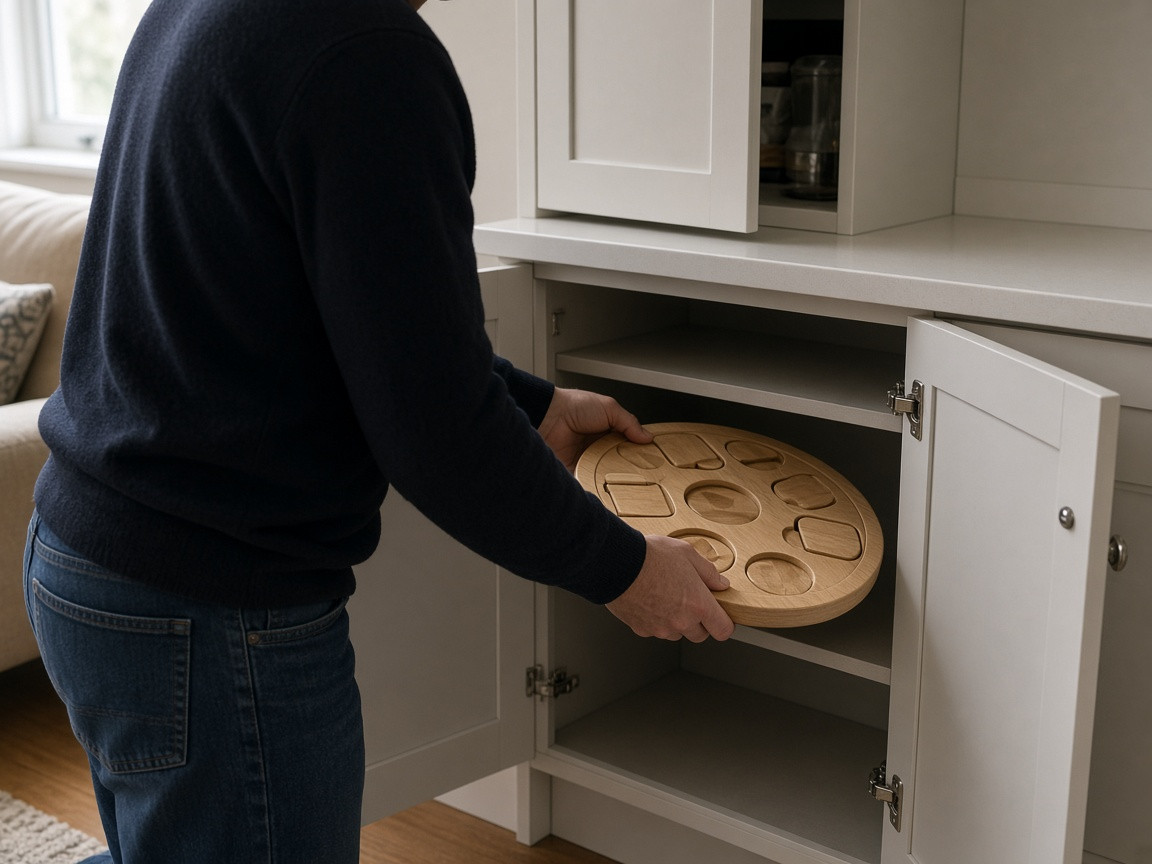
Set the toy on a non-slip surface where it cannot disappear under a sofa. Stay present until you know whether this dog works the puzzle or tries to break it. When the food is gone, pick the toy up. An empty puzzle left on the floor becomes a chew.
Wash it as a food object. Kibble dust and saliva collect in sliders, corners, and rubber nubs. If the design cannot be cleaned, it is a poor everyday toy, no matter how clever it looks.
Keep sessions short enough that the dog is still thinking at the end. For many dogs, ten to twenty minutes, or one meal portion, is enough. Ending on a success is better than letting them grind on an empty or unsolvable toy.
In a multi-dog home, offer puzzles one dog at a time, in a separate space, and put them away after. Do not use a puzzle as a way to “keep them both busy” in the same room if either dog guards food.
Common mistakes
Starting at a high level because the dog is young, busy, or “too smart for easy toys.” Easy success is the training. Hard failure is often just destruction.
Shopping from a best-of list and skipping the difficulty question entirely.
Leaving the puzzle out all day, or using it as unsupervised crate entertainment before you know it is safe.
Adding puzzle treats on top of full meals.
Offering a hard puzzle right after a flirt pole, a game of fetch, or any session that already raised arousal. That is the moment for an easy search or a known, simple puzzle, not a new sequence.
Giving two dogs one toy.
Treating chewing, dumping, or frantic pawing as a sign that you should buy a more advanced puzzle. Those are usually signs to go easier, change the tool, or stop.
Never washing the toy.
Hoping a puzzle will replace a walk, a sniffy outing, or teaching the dog to settle.
How a puzzle should share the job with other tools
A dog puzzle toy is for problem-solving. The value is the work: figuring out a step, staying with a task, getting paid for it. It can be scaled up as the dog learns. It can also be too much, especially when the dog needed to calm down rather than crack a harder problem.
A snuffle mat is for foraging. The dog uses their nose, the difficulty is mostly how deep the food is hidden, and the session often lands quieter than a hard puzzle. If the job is a search or a cool-down, use the mat—or another easy sniffing task, or a lick mat—and save the puzzle for a different window. Which dogs should skip a mat, and how to use one, is covered in our snuffle mat guide.
A slow-feeder bowl is for slowing a meal with less thinking and less mess. It is usually more durable and easier to clean. If your only problem is speed-eating, start there. If your problem is a dog that needs a job, the bowl will feel boring, and a Level 1 puzzle or a snuffle mat will do more.
A flirt pole or a game of fetch turns chase and arousal up. A puzzle is not automatically the right follow-up. After a short, low-to-the-ground chase, switch to something easier and quieter. Use a harder puzzle later, or on a rest day when you want brain work without impact on shoulders and joints.
A practical split looks like this: everyday meals in a slow feeder if you need something washable and daily; a snuffle mat when you want a search or a come-down; a puzzle when you want the dog to think, at a level they can still win.
A simple way to try one
- Start at Level 1, with a portion of regular kibble, on a non-slip floor, with you in the room.
- Let the dog succeed. If they get stuck, show them once, then let them finish.
- If they work calmly and leave the toy intact, you can add slightly more hiding or a second step next time.
- If they chew, dump, guard, or quit, go easier, switch to a slow feeder or a snuffle mat, or stop.
- Wash the toy, put it away, and do not use a harder puzzle as a cool-down after intense play.
If the dog loves working but wrecks every complex board, keep them at a simple, durable level and give them other jobs for the rest of the day. That is a successful plan, not a dog who “outgrew” puzzles.
FAQ
What is a dog puzzle toy?
A toy the dog has to manipulate to get food: sliding, lifting, rolling, or working a sequence. It is a short problem-solving session, not a chew, and not a toy that should sit out all day once the food is gone.
What difficulty should I start with?
Level 1, even if your dog seems sharp. The first job is to teach them that the toy pays and that they do not need to break it. Move up only after calm, complete sessions.
How do I know the puzzle is too hard?
The dog quits, barks at the toy, bites or shreds it, cannot get the food without you, or gets more agitated as the session goes on. Make the next session easier, or change tools. Do not add difficulty on top of frustration.
How do I know it is too easy?
The dog finishes immediately, stays calm, and looks for more work. Hide the food a little better, add one step, or split the same meal across two short sessions. You do not have to jump a whole level just because one session was fast.
Can I leave my dog alone with a puzzle toy?
Not until you have watched enough sessions to know they will not break or swallow parts, and not with another dog present. Even then, pick the toy up when the food is gone. An empty puzzle is a chew toy with removable pieces.
How often should we use one?
A few short sessions a week is enough for many dogs. Some will do a simple puzzle daily. Daily advanced work is usually too much: more washing, more frustration, and more wear on the toy. Rotate with sniffing, chewing, and real rest.
Is a puzzle better than a snuffle mat or a slow-feeder bowl?
It is different, not better. A puzzle is for thinking. A snuffle mat is for searching. A slow-feeder bowl is for slowing down a meal with less fuss. Many dogs can use more than one, in different parts of the day, at a difficulty that still lets them win.
Will a puzzle toy stop barking or chewing the furniture?
Not by itself. It can occupy a dog for a short, food-based window. If the dog is barking from under-exercise, fear, or rehearsal, a harder puzzle will not fix the cause, and a destroyed puzzle may make the day worse.
Can puppies, large dogs, or seniors use puzzle toys?
Yes, if the pieces are appropriate and the difficulty is honest. Puppies need large, sturdy parts, easy wins, and supervision so the puzzle does not become a teething chew. Large dogs need a toy they cannot crush or swallow in pieces. Seniors often do better with easier puzzles, shorter sessions, and food that is not difficult to eat. Ask your veterinarian if the dog is in pain or recovering from an injury.
My dog just chews the puzzle. Now what?
Stop using that toy if pieces can be swallowed. Go back to an easier, more durable design, or switch to a slow feeder or a supervised snuffle mat. Chewing the puzzle is information: the challenge, the material, or the moment in the day was a mismatch. It is not a reason to buy a more advanced one.