Indoor Cat Toys
Interactive Cat Toys for Indoor Cats: Apartments, Multi-Cat Homes, and Days You're Away
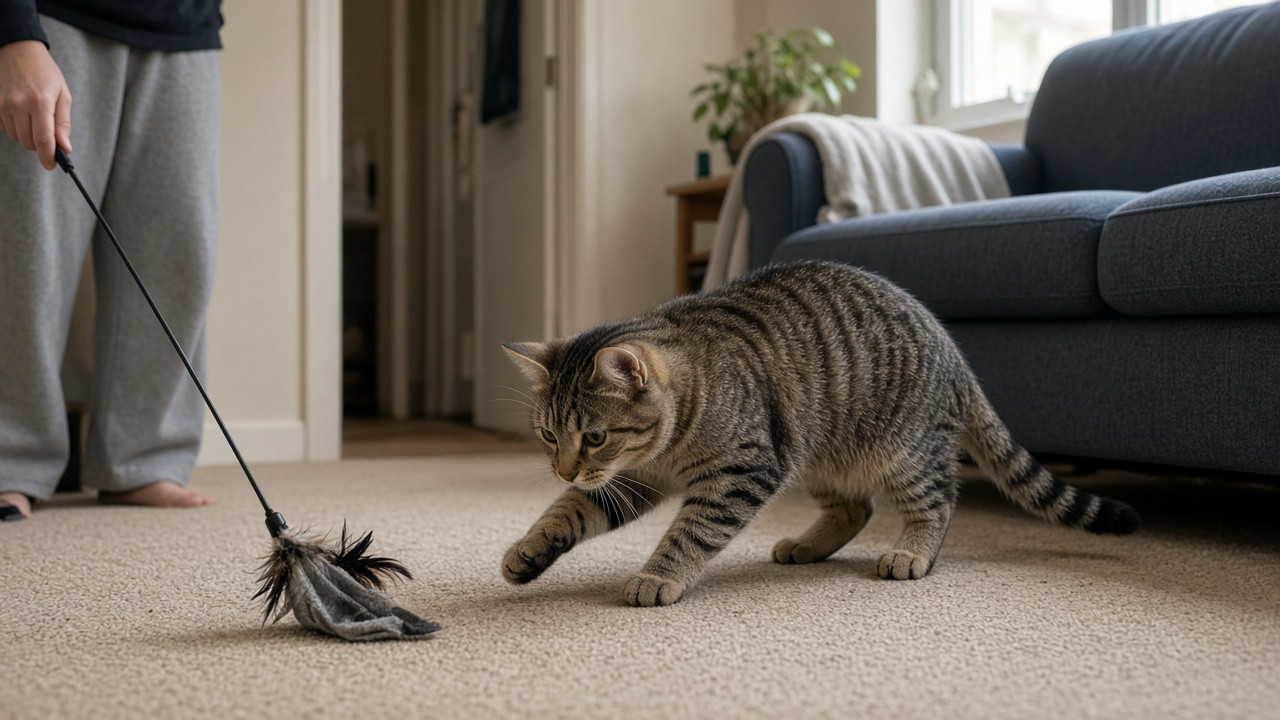
Choose interactive cat toys for indoor cats by situation: what works in tight apartments, multi-cat homes, and workdays alone—not a generic best-of list.
Indoor cats do not need more toys in a pile. They need play that fits the room, the household, and the hours you are actually gone.
The same long wand that works in a house can take out a lamp in a studio. A toy two cats are supposed to “share” can become something one cat guards. And a motorized toy is not a substitute for a short hunting session when you get home—though it can fill the middle of a workday if you choose it for unsupervised use.
Pick interactive cat toys for indoor cats by situation first: a tight apartment, a multi-cat home, or a day when no one is there. A generic “best for bored indoor cats” list usually skips those constraints. This guide does not rank products. It helps you match the kind of play to the life you actually have.
What “interactive” needs to mean here
For this guide, an interactive cat toy is one that responds to the cat, or to you, in a hunting sequence: stalk, chase, pounce, and—when the session goes well—a catch.
That includes a wand or teaser you hold, a motion toy that starts and stops, and, in a different window of the day, a puzzle that makes the cat work for food. It does not include a stuffed mouse left on the floor all week, a cat tree, or a window perch. Those can still matter. They are just doing other jobs: rest, territory, and watching the street.
If the cat cannot complete a hunt, the toy is only half-interactive. That is why a laser, used alone, is a weak plan for an indoor cat, and why a toy that only spins in place often turns into something the cat stares at.
Situation 1: Tight apartments and small rooms
In a small space, the limiting factor is almost never “not enough toys.” It is the lane you have to play in.
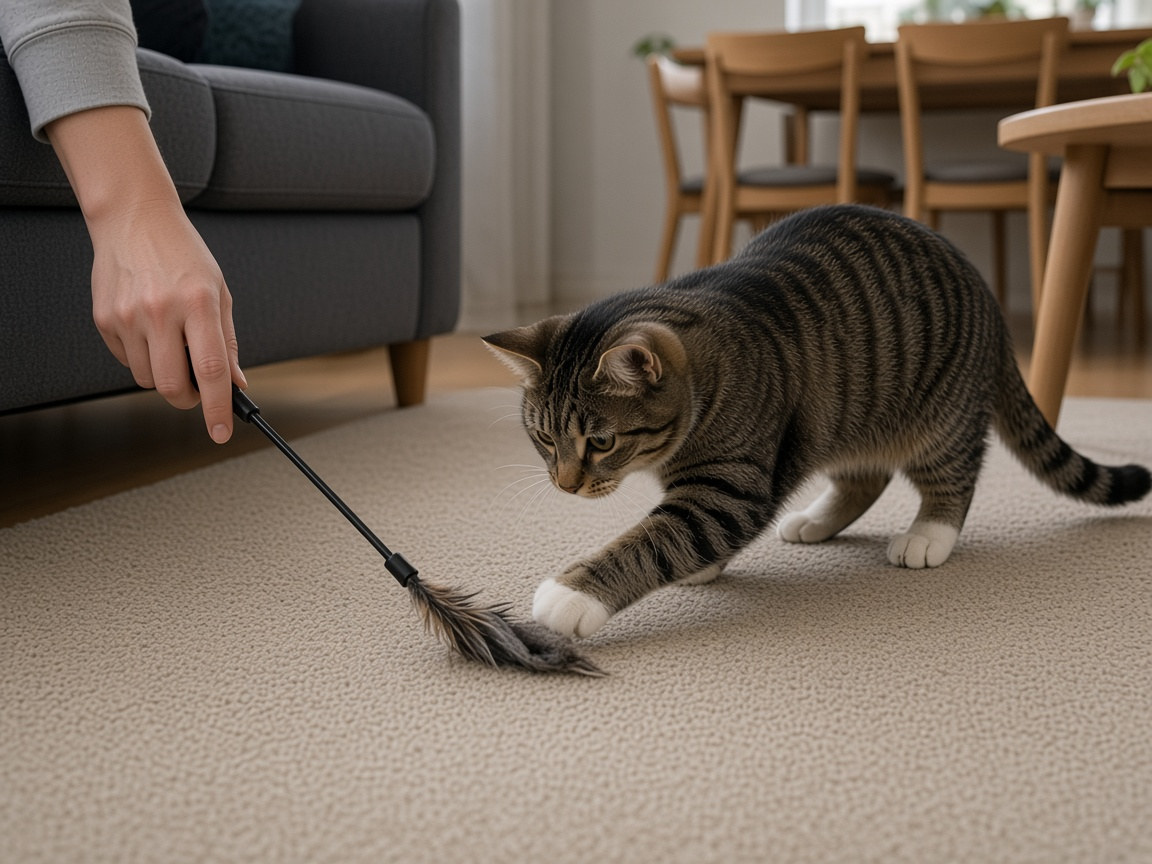
Before you add anything new, clear a short, repeatable path: a hallway, the length of a sofa, or a rectangle of floor with chairs pushed in. You will use that same path most days. A wand with a long, unpredictable reach is hard to control in a cluttered studio. A shorter wand, or a teaser you can keep low to the ground, is usually easier to aim and easier to end on a catch.
Watch the furniture as carefully as you watch the cat. Rolling and wandering toys disappear under low sofas and TV stands. If you cannot retrieve the toy quickly, your cat will either lose interest or spend the session fishing under a couch. For any toy that moves on its own, test it in the real room first.
Noise matters more in an apartment than product videos suggest. A toy that beeps, talks, or whines can startle the cat and bother a neighbor. For daytime use, a relatively quiet motor beats a “fun” soundtrack.
Vertical space helps an indoor cat feel like the room is larger, but a cat tree is not a play session. Use the tree or a sturdy shelf as a launch point or a lookout, then bring the toy back down to the floor so the cat can pounce and finish. Window time is enrichment, too. It is not a substitute for a hunt.
Situation 2: Multi-cat homes
Do not assume two cats will take turns. Some will play in parallel. Some will not. One cat may guard a motorized toy, steal the wand, or escalate until the other cat leaves the room.
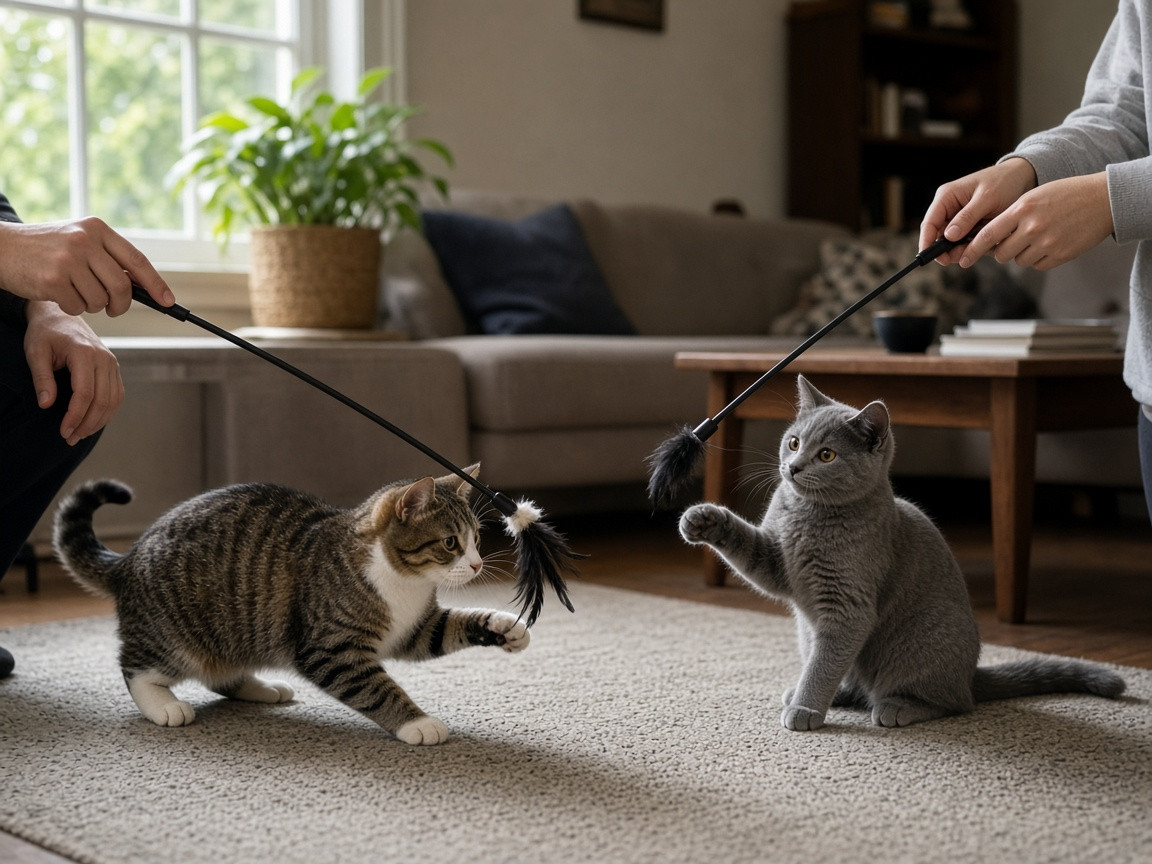
Watch the first few sessions instead of buying a second, louder toy. If one cat consistently blocks the other, split the play: two short sessions, or two teasers at once if you can keep both cats ending on a catch. “Together” is a bonus, not the goal. Each cat needs a complete sequence, including a catch or a small food reward at the end.
Intensity is often uneven. A high-drive cat can overstimulate in a minute; a shy cat may only watch. If you play them at the same time, the session will usually be pitched to the more intense cat. Separate windows fix that more reliably than a new gadget.
Keep enough of the same kind of resource that the toy itself does not become a flashpoint—two similar kickers, two resting spots, two ways to end the hunt. If tension already exists between the cats, treat play as a time you manage, not as a self-serve bowl you leave in the middle of the room.
Situation 3: Days when no one is home
This is the situation people try to solve with one purchase. It usually takes two kinds of play, at two times of day.
When you are gone, the toy has to be safe without you in the room. That is a narrower job than “interactive.” Long wand strings, ribbons, and charging cables should not be left out. A motion toy can help if it stays in a bounded area, is quiet enough for the space, still has power for a few short sessions, and gives the cat something physical to bat—not only a light. How to choose one of those is covered in our guide to automatic cat toys for indoor cats left alone.
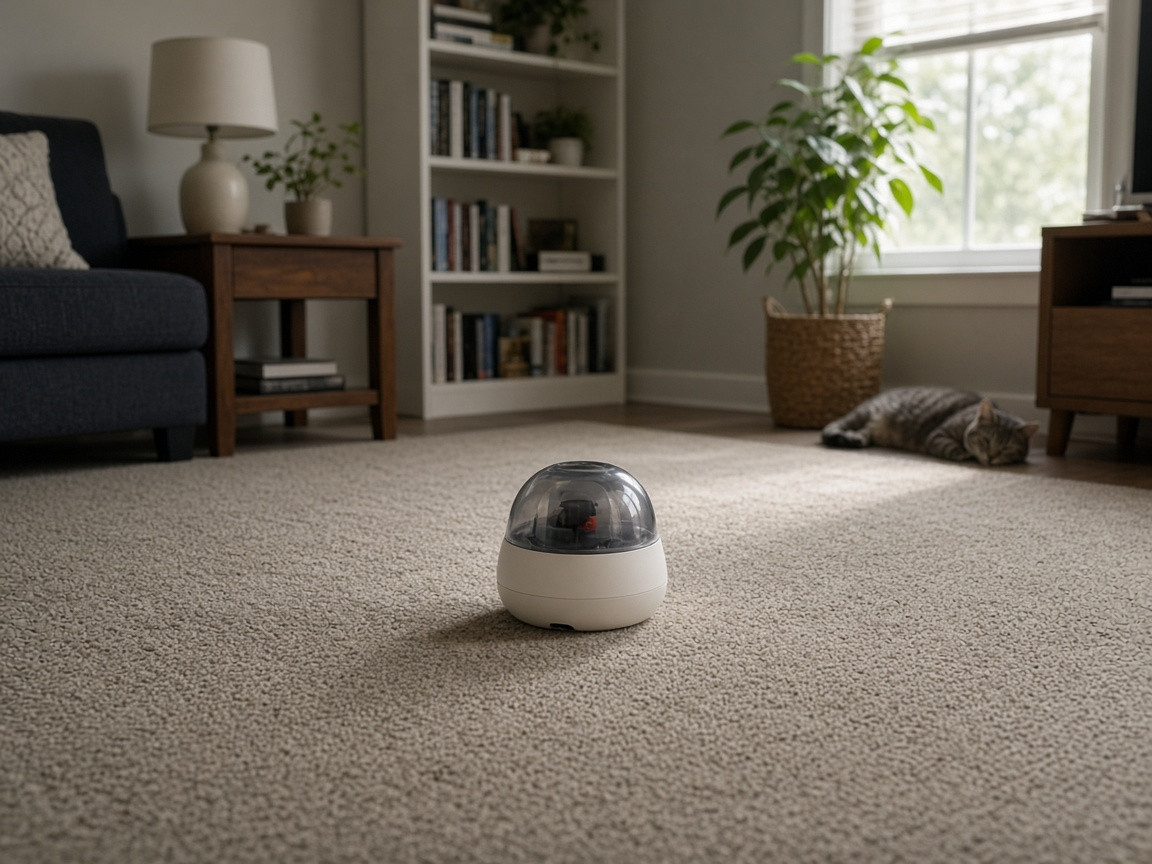
When you get home, do a real session yourself. Ten to fifteen minutes with a wand, ending on a catch, does a job the machine cannot: you control the pace, you can stop before the cat goes frantic, and the cat gets play with you. An automatic toy that ran at 2 p.m. does not replace that.
A food puzzle or slow feeder can occupy another window, usually around a meal. It is not the same as a hunt, and it should not be asked to be. Used on a workday, it is a useful third piece: a short automatic session, a food puzzle, and a wand session when you walk in.
If you only add a motorized toy and change nothing about the evening, most indoor cats will still meet you at the door wound up. The gap you needed to fill was only half the problem.
How to choose, once you know the situation
After you know whether you are solving for space, for more than one cat, or for hours alone, the rest of the choice is consistent.
Can the cat finish the hunt? Prefer toys the cat can bat, pin, or briefly catch. If you use a laser at all, end with a physical toy or a treat. Do not aim a laser at a cat’s eyes.
Can you control intensity and stop? A toy you hold is easier to pace than one that runs until the battery dies. For unsupervised time, prefer a timer or auto-off after 10–15 minutes, and shutoff if the toy gets stuck.
Is it still safe if a part comes off? Feathers, clips, and felt mice detach. Strings and elastics can wrap. Anything you leave out when you are gone should remain safe after it loses its most tempting piece.
Does it fit the room and the social setup? Test moving toys in the real furniture layout. In a multi-cat home, watch for guarding before you decide the toy “works.”
Will you actually rotate it? A toy that stays on the floor all week becomes furniture. Put teasers away between sessions. Use automatic toys on a schedule, not as all-day background motion.
Common mistakes
Leaving every toy out at once, then deciding indoor cats “get bored with toys.” They often get bored with toys that never go away.
Using only a laser and never offering a catch. The chase happens. The sequence does not finish.
Calling a 60-second burst a play session. Most indoor cats do better with a few 10–15 minute sessions than with a frantic sprint on your way out the door.
Forcing two cats to share one toy, or pitching every session to the most intense cat in the room.
Leaving wand strings, ribbons, or charging cables out “just for now,” then walking out for the day.
Expecting a window perch, a cat tree, or a pile of mice to replace interactive play. Those help. They are not the hunt.
Ending the session when the cat is at peak frenzy. Try to end on a catch, then let the cat eat, groom, or settle. If a cat is overstimulated—biting hands, crashing into furniture, unable to stop—the session ran too long or too hot.
Using the same plan for a shredding kitten, a high-energy adult, and a sound-sensitive older cat. A kitten that is chewing everything may need teething toys and supervision more than a new motorized gadget.
How these toys differ from nearby options
Interactive play you hold is for when you are there. Automatic motion toys are for the gap in the middle of the day. They complement each other; they are not interchangeable. If you are choosing a toy to leave running while you work, use the automatic-toy checklist—furniture, noise, power, and a catchable object—rather than this page’s broader situation plan.
Lasers are filed next to interactive cat toys in a lot of stores. They trigger chase and usually deny the catch. For indoor cats, that is a poor unsupervised option and only a partial supervised one. If you use a laser, finish with something the cat can actually grab.
Puzzle feeders and slow-feed bowls occupy a different drive: working for food. They are useful on the same day as a wand session. They will not satisfy a cat that needed to hunt.
Static toys, trees, and scratchers support rest, claws, and territory. Buy them for those jobs. Do not count them as interactive play just because they live in the same room.
A simple daily shape for each situation
In a tight apartment: a short morning wand session in your clear lane, a food puzzle as you leave if the cat is food-motivated, and a second wand session when you get home, ending on a catch. Add an automatic toy only after it has passed a test in that same room.
In a multi-cat home: give each cat a complete session, together only if both stay comfortable. Watch for guarding. Keep a second way to end the hunt so one toy does not become the only prize.
On days you are gone: keep unsupervised play short, bounded, and string-free. Keep the evening session. That is the plan, not a backup.
If a setup fails, change the situation variables first—the room, the timing, the number of cats in the session—before you assume you bought the wrong category of toy.
FAQ
What counts as an interactive cat toy for indoor cats?
A toy that lets the cat hunt: something that moves in response to you or to the cat, and that can end in a bat, pounce, or catch. Wands, teasers, and well-chosen motion toys qualify. A mouse left on the floor, a cat tree, or a window view usually does not, even if the cat likes them.
How often should I play with an indoor cat?
Most indoor cats do well with at least one real session when you are home, and two is better if you can manage it—often morning and evening, about 10–15 minutes each, ending on a catch. Short and complete beats long and chaotic. Adjust for the cat in front of you: kittens and high-drive adults may want more; older or easily overstimulated cats may need less.
Are automatic toys interactive enough on their own?
They can be interactive in the sense that they move and the cat can chase them. They are not enough on their own. Use them for the hours you are out, then do a session you control when you get home. For the unsupervised half of that plan, see our guide to automatic cat toys.
My cat just watches and will not play. Now what?
The toy may be too fast, too loud, too unpredictable, or impossible to catch. Try a slower wand session in a quiet room, end early on a catch or a treat, and give a shy cat a day or two to approach a new object. In a multi-cat home, try a session without the more intense cat in the room.
Can two indoor cats play with the same toy?
Sometimes. Watch rather than assume. If one cat guards the toy or the other consistently bows out, split the sessions or offer a second teaser. The goal is a complete hunt for each cat, not a group activity that looks good from the doorway.
Are laser pointers okay for indoor cats?
They are a weak standalone option. The cat can chase but usually cannot catch the light, and some cats stay amped up or search the floor afterward. If you use one, end with a physical toy or a treat, and never aim the light at a cat’s eyes. For time when you are not home, prefer a toy with a real object the cat can bat.
I live in a small apartment. Do I need a lot of space to play?
No. You need one clear, repeatable lane and toys you can keep inside it. Play low, end on a catch, and skip toys that immediately disappear under furniture. Vertical space is a bonus for resting and watching, not a requirement for a good session.
What if my indoor cat is a kitten that chews everything?
Be more conservative with strings, small parts, and anything left out unsupervised. Chewing is often a teething problem, not a sign that you need a more exciting interactive toy. Supervised wand play can still work; the chewable items themselves belong in a teething plan.