Indoor Cat Toys
How to Choose a Cat Puzzle Feeder—and Which Cats Should Skip One
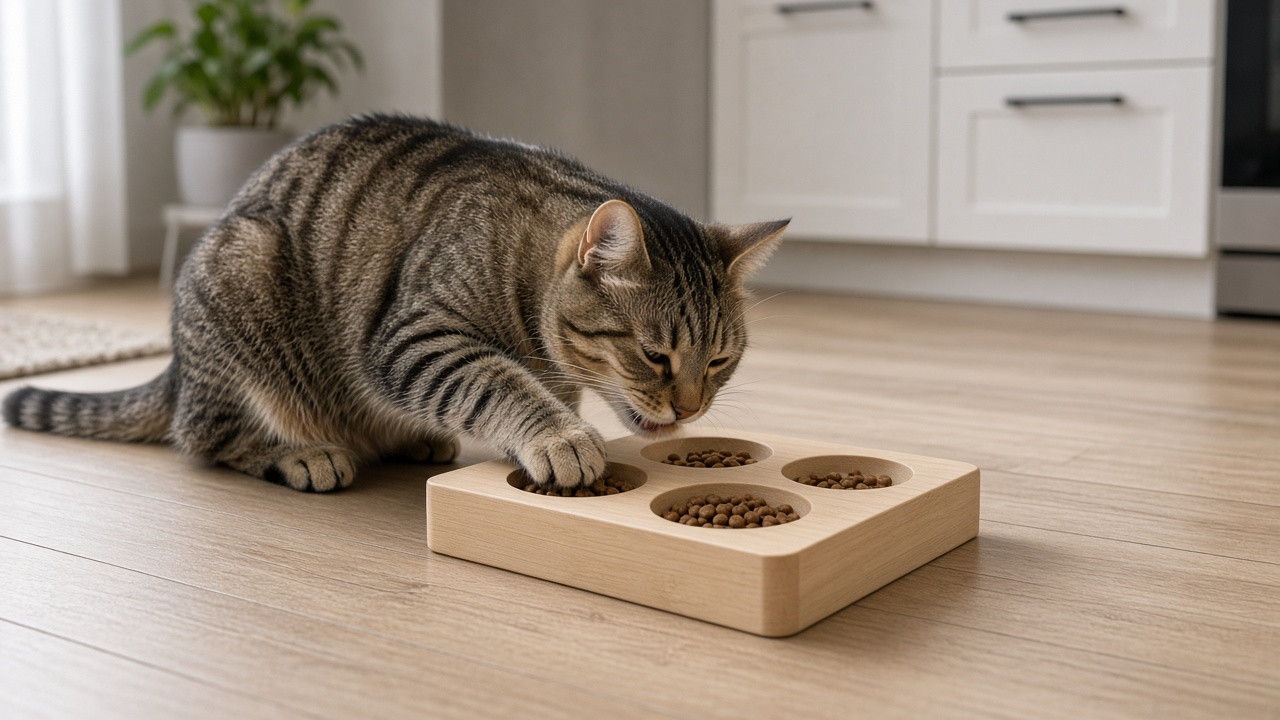
Choose a cat puzzle feeder by difficulty, use it with dry or wet food, learn which cats should skip it, and how it differs from play toys and slow-feed bowls.
A cat puzzle feeder makes an indoor cat work for a meal. It is a feeding tool, not a play toy. The models that fail usually fail in the same places: the puzzle is too hard, the food does not match the design, the cat cannot be left with it, or you are asking a meal to do the job of a hunt.
Many searches for cat puzzle toys are looking for the same thing. If the object releases food when the cat paws, rolls, slides, or licks it, it belongs in this guide. A wand, a motorized ball, or a laser is a different job, even when a store shelves them together.
This guide is about how to choose a difficulty the cat can finish, how to use dry or wet food, and which cats should skip a puzzle feeder. It is not a ranked list of products.
When a puzzle feeder actually helps
A puzzle feeder is most useful when the gap you are trying to fill is a meal, not a chase:
- The cat eats so quickly that meals disappear in a few swallows, and you want the same portion to last a little longer.
- The cat is food-motivated and can use a short problem as a job at breakfast or dinner.
- You want indoor time that occupies the cat around a meal, without turning on a motorized toy.
- You already have play planned for when you are home, and you need a separate tool for feeding.
It is the wrong tool, or the wrong time to use one, when:
- The cat is not interested in working for food and will walk away still hungry.
- A veterinarian has asked you to make eating easier, or the cat is underweight, recovering, or having trouble chewing.
- Two cats already guard food, and you do not have a way to feed them apart.
- A kitten still swallows small parts, or still needs reliable, easy access to enough calories.
- You are hoping the feeder will replace interactive play or an automatic toy. It will not.
If the cat needs a hunt, give them a hunt. If the cat needs a meal they can actually finish, start with a feeder they can beat.
How to choose one the cat can finish
1. Start easier than the toy looks
Difficulty is not a selling point. It is a match between the cat in front of you and the number of steps between them and the food.
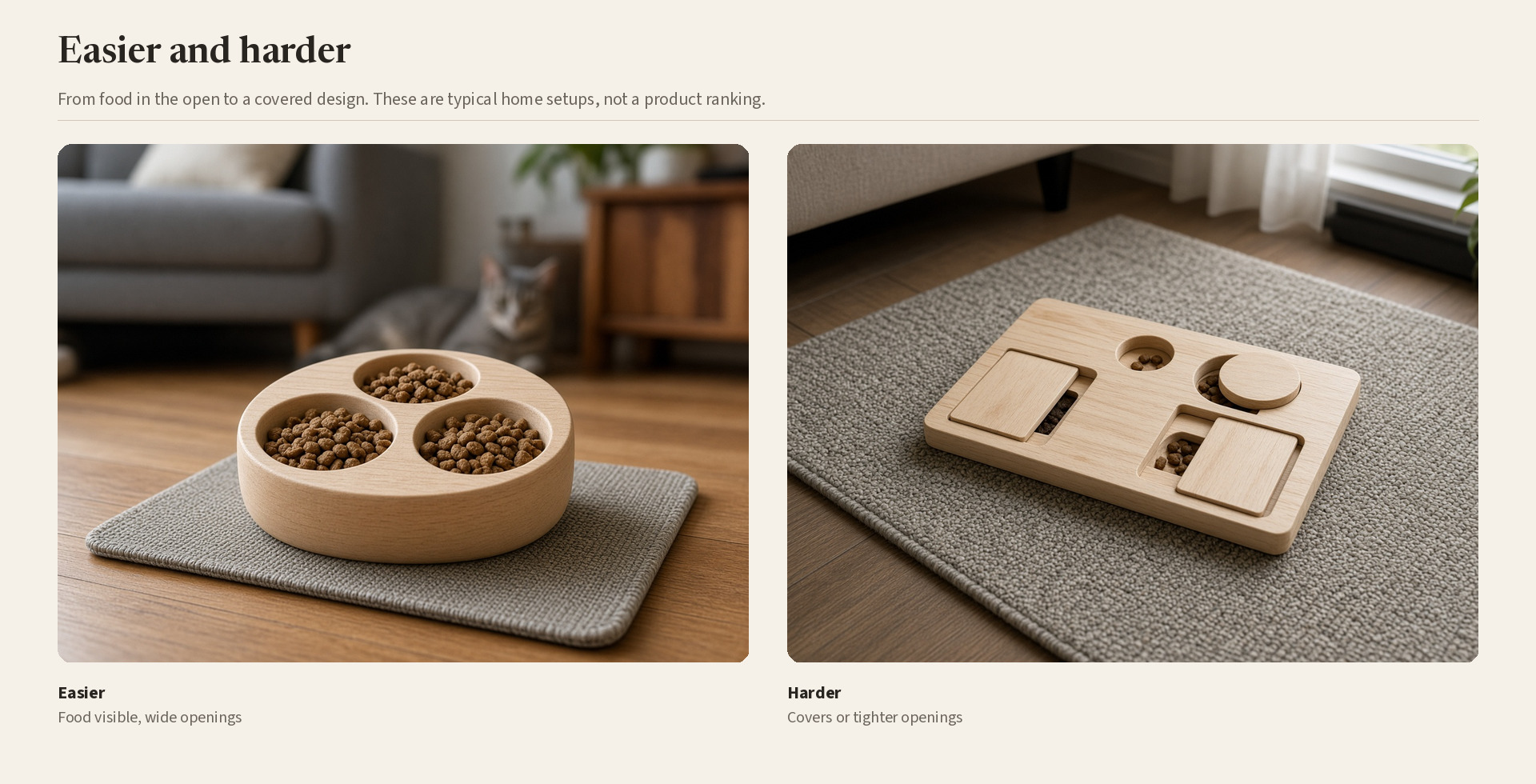
- Easy: the food is visible, or almost visible. Open wells, wide holes, or a shallow tray the cat can paw or lick without a trick. The first session should feel almost too simple.
- Intermediate: some of the food is covered or tucked into a second step—sliding lids, tighter openings, a ball that has to be rolled with more purpose. The cat can still finish a normal portion without help.
- Advanced: long sequences, tight tolerances, or several moves before a single piece comes out. This is a poor first feeder. Many cats quit, then look for an easier source.
Move up only after the cat finishes calmly, leaves the feeder intact, and still eats a normal amount. If a session regularly ends with leftover food the cat could not reach, or with a frustrated walk-away, go back a step. Count the food as part of the day’s meals. A puzzle is enrichment. It is still calories.
2. Match the feeder to dry food or wet food
The food you actually serve matters more than the shape on the box.
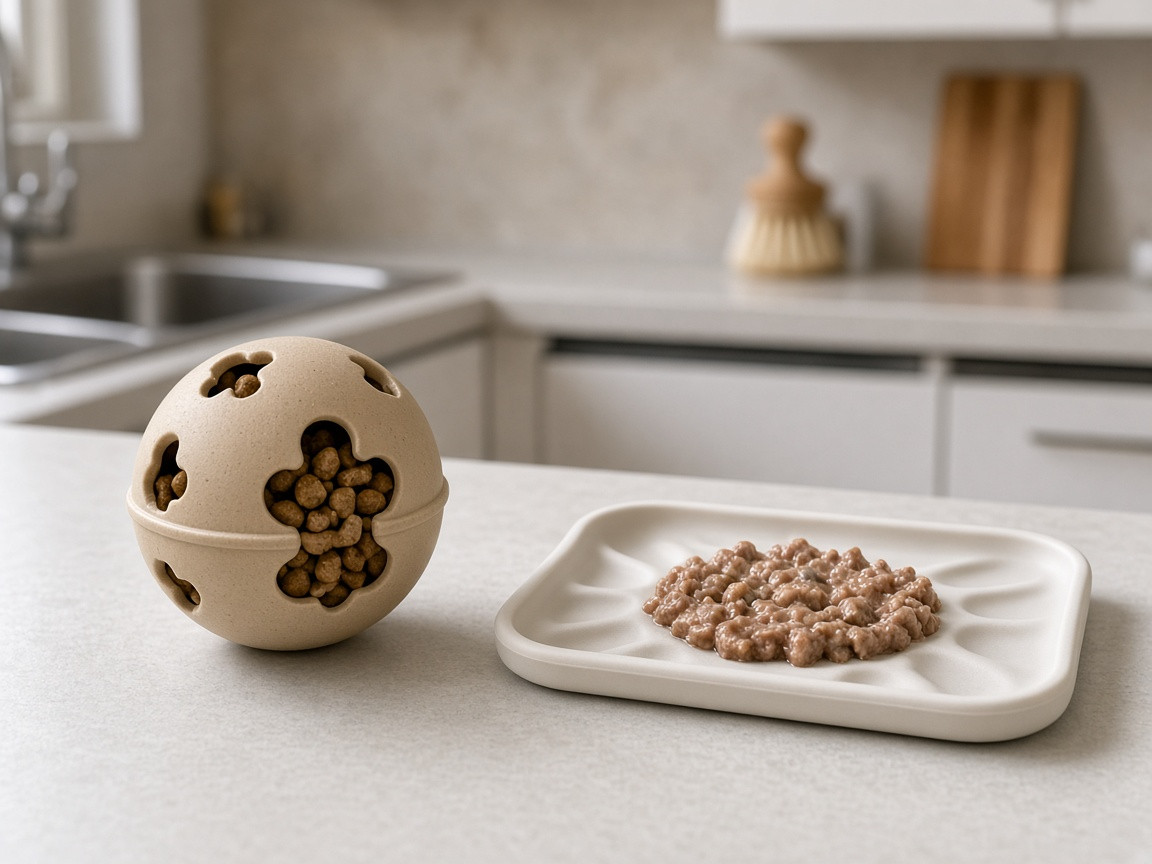
Dry food and kibble work in rolling balls, boards with wells, and toys with openings. The pieces have to fit the holes: too loose, and the meal dumps out in one shake; too tight, and the cat cannot get a full portion. Check that a normal piece can come out with pawing or rolling, and that the whole meal does not empty if the cat knocks the toy once.
Wet food belongs in a design meant to hold it: a shallow tray, a lickable mat-style surface, or wide, stable wells. Do not pack wet food into a dry-food ball or a narrow rolling toy. It will clog, spoil, or get flung onto the floor. Serve wet food for a meal, then wash the feeder. Do not leave wet food sitting out for hours.
If you switch between dry and wet, use a feeder that can be cleaned well enough for both, or keep two simple tools rather than forcing one object to do both jobs.
3. Check stability, parts, and cleaning
A feeder that tips and dumps may be exciting once and useless after that, unless a small dump is the intended, easy mechanic. For most meals, you want a stable base the cat can paw without flipping the whole portion onto the floor.
Inspect the parts the cat will have in their mouth. Avoid small clips, loose caps, and thin pieces that can break off and be swallowed. If the cat is a chewer, a flimsy plastic shell is a poor unsupervised choice.
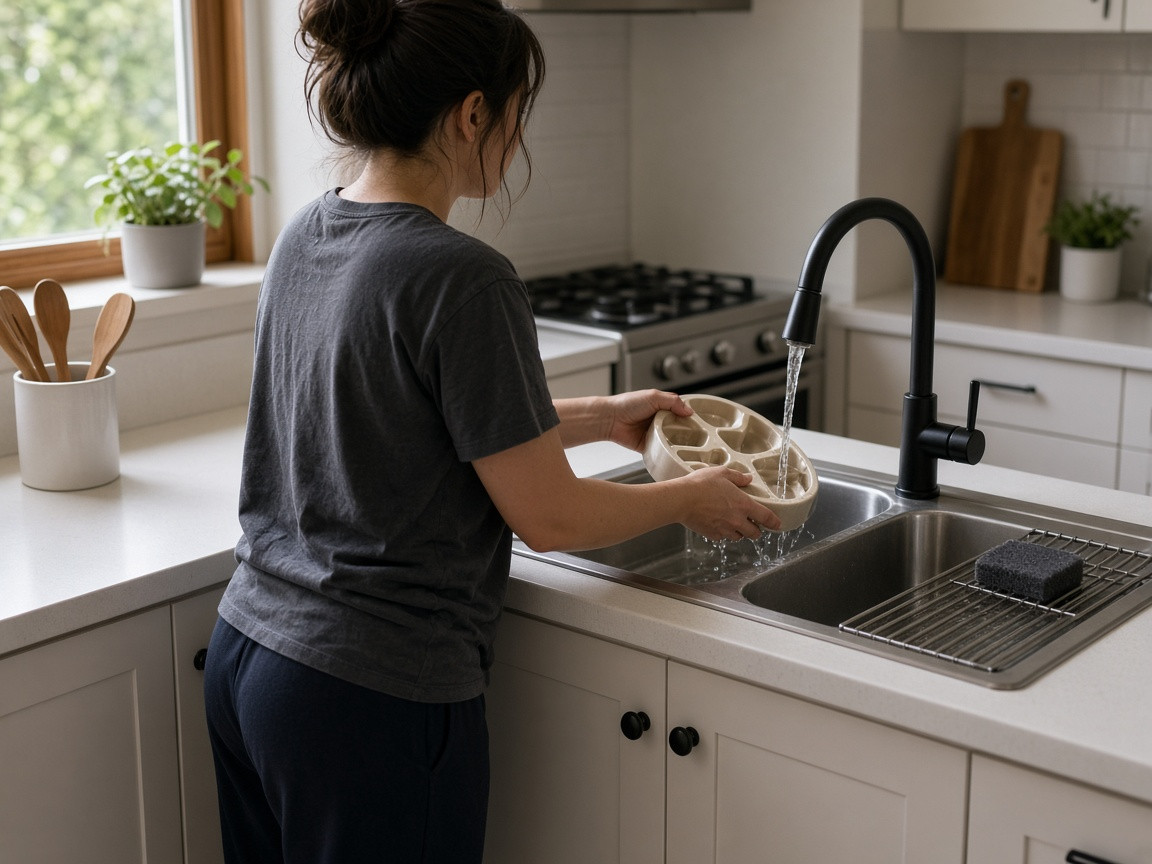
Anything that holds food has to be washed like a food tool, not like a toy you occasionally wipe. Wet food needs a real wash after every use. Dry-food feeders still collect grease, saliva, and crumbs; wash them often enough that the next meal does not start on yesterday’s residue. If you cannot take the feeder apart enough to clean it, it is a weaker everyday option.
4. Know which cats should skip it
Some cats should not be asked to work for food, or should only try a feeder under closer watch:
- Cats that need easy calories. If a cat is underweight, recovering, or has been told not to slow or complicate meals, do not add a puzzle. When in doubt, ask your veterinarian before you change how the cat gets food.
- Cats that already struggle to chew or that drop food because eating is uncomfortable.
- Cats that guard meals. A puzzle can become a resource to defend, especially in a multi-cat home.
- Very young kittens that still swallow small parts, or that cannot afford a missed portion. Teething and chewing are a different problem; that belongs with teething toys, not with a meal puzzle.
- Cats that only get frustrated. If easier food is available elsewhere, or the cat leaves hungry, the tool is not helping.
A skip is not a failure. A slow-feed bowl, or a normal bowl, is the better tool when the puzzle gets in the way of eating.
5. Introduce it as a meal, then put it away
Show the cat that the object pays. For the first session, leave some food in plain view—on the lip, in an open well, or smeared where the cat will smell it immediately. Stay in the room. Let them finish. Then wash the feeder and put it away.
Do not leave a new puzzle down all day “to see what happens.” You need to know whether the cat can get the food, whether pieces come off, and whether another cat moves in. Once the cat is fluent with an easy version, you can use it as a regular meal while you are home. Only later consider a stable, already-tested dry-food feeder for a short stretch while you are out.
When the food is gone, pick the feeder up. A puzzle left on the floor becomes clutter, and a half-finished wet meal becomes a hygiene problem.
Common mistakes
Starting with an advanced design because the cat is “smart.” Intelligence is not the same as a willingness to work through a tight, unfamiliar meal. Easy first is still the right first step.
Using the feeder as a stand-in for play. A finished meal does not complete a hunting sequence. The cat can eat from a puzzle at breakfast and still need a wand session that ends on a catch.
Leaving wet food in the feeder for hours, or packing wet food into a dry-food toy. The first is a food-safety problem. The second is usually a jammed, messy toy.
Putting one feeder down for two cats and walking away. If there is any tension around food, feed them separately.
Never washing the feeder, or assuming dry kibble makes cleaning optional.
Treating every “cat puzzle toy” as a chase toy. If there is no food involved, you are shopping in a different category. If there is food involved, judge it as a meal tool: difficulty, food type, and whether this cat should use one.
How a puzzle feeder differs from nearby options
A puzzle feeder occupies a cat by making them work for a meal. That is a different drive from play.
Automatic toys are for a short hunting burst while you are gone—motion the cat can actually bat, in a room the toy will not disappear into. They do not serve breakfast. A feeder and an automatic toy can live in the same day, in different windows. One does not replace the other.
A wand or tease toy is for when you are there. You control the pace and can end on a catch. How to shape that kind of interactive play for apartments, multi-cat homes, and workdays is a separate plan. The feeder is the meal in between, not a substitute for that session.
A slow-feed bowl is the closer cousin. It slows a meal with less problem-solving. Choose it when you mainly want the cat to eat more slowly, or when a puzzle has already proved too frustrating. A puzzle is for a cat that will still finish after a few extra steps.
Homemade treat puzzles—an egg carton, a rolled paper bag, a muffin tin—can be a fair, easy first try if they are stable, free of staples and tight plastic, and used only while you are watching. They are a way to test the idea, not a reason to skip the difficulty and hygiene questions above. This page is about choosing and using a feeder, not a craft project.
Dogs have their own versions of this job. A dog puzzle toy or a snuffle mat is built for a different mouth, size, and chewing style. Do not hand a cat a large, hard dog puzzle and assume the difficulty will translate. The shared idea is simply this: slowing a meal and giving the animal a job are not the same as a chase.
A simple way to try one
- Pick an easy feeder that matches the food you already serve—dry in a design with openings that fit the kibble, or wet in a shallow, stable tray.
- Use part of a regular meal, not a stack of extra treats. Subtract what you put in the feeder from the day’s total.
- Start with some food in plain view so the cat learns that the object pays.
- Stay for the first sessions. Watch whether the cat can finish, whether the feeder tips or sheds pieces, and whether another cat interferes.
- If the cat works calmly and eats a normal amount, you can add a slightly harder step next time. If they dump, chew, guard, or quit, go easier, switch to a slow-feed bowl, or stop.
- Wash the feeder, put it away, and do not ask it to replace a play session when you get home.
If the cat loves working at mealtime but wrecks every complex design, keep them at a simple, durable level. That is a successful match.
FAQ
What is a cat puzzle feeder? Is that the same as a cat puzzle toy?
Usually, yes. A cat puzzle feeder makes the cat work to release food—rolling, sliding, pawing, or licking it out. Many products labeled cat puzzle toys are the same kind of meal tool, not a wand or a motorized chase toy. If the object does not involve food, it is doing a different job.
What difficulty should I start with?
Start easier than the toy looks. Food should be visible, or almost visible, and the cat should be able to get most of a normal portion without help. If the first session takes a long time or the cat walks away still hungry, the feeder is already too hard.
Can I use wet food in a cat puzzle feeder?
Only in a design meant to hold it: a shallow tray, a lickable surface, or wide, stable wells. Do not pack wet food into a dry-food ball or a tight rolling toy. Serve it for a meal, then wash the feeder. Do not leave wet food sitting out for hours.
How long should a session last?
A puzzle feeder is a meal, not an all-day activity. Most cats should be able to finish a normal portion in a comfortable meal window. If it routinely takes so long that the cat gives up, or so little time that the food dumps out at once, adjust the difficulty or switch tools.
Can I leave my cat alone with a puzzle feeder?
After you have watched the cat use that feeder with that food. Stay for the first sessions. If the cat chews the toy, swallows pieces, guards it, or cannot get the food out, do not leave it down while you are out. Wet food should not be left out unattended for a long stretch.
Which cats should not use a puzzle feeder?
Skip it, or get advice from a veterinarian first, if the cat needs easy access to calories, is underweight or recovering, has trouble chewing, or has been told not to work for meals. Also skip it for a cat that guards food, a kitten that still swallows small parts, or a cat that only gets frustrated and walks away hungry.
Will a puzzle feeder replace playtime?
No. Working for food is not the same as a hunt you can finish. Keep a real play session—such as a wand session that ends on a catch—and use the feeder at mealtime. An automatic toy and a puzzle feeder can share a workday; neither one replaces you.
Can two cats share one puzzle feeder?
Not as a default. One cat may keep the other away, or both may crowd a single food source. Feed them in separate spots, or one at a time, until you know there is no guarding. Adding a harder feeder will not fix a conflict.
Is a puzzle feeder better than a slow-feed bowl?
It is different, not better. A slow-feed bowl mainly slows the meal. A puzzle adds steps the cat has to figure out. If the cat only needs to eat more slowly, a simple slow-feed bowl may be enough. If the cat enjoys a short problem at mealtime and can still finish, a puzzle is a reasonable next step.
My cat tips the feeder over, or ignores it. Now what?
A dumped feeder is information, not a reason to buy a harder one. Try a more stable design, start with food in plain view, or switch to a shallow tray or a slow-feed bowl. If the cat ignores it, the food may be too hard to reach, the puzzle may not smell like a meal, or this cat may simply not be food-motivated enough for this tool.